The future of online archives in 2009
Way back in 2009, I was working in the web content team at the National Archives of Australia (NAA). We’d been doing some pretty interesting work on projects like Mapping Our Anzacs, that brought together map-based finding aids and crowdsourced contributions. So when the NAA was asked to report on ‘emerging technologies for access’ by the Standards for Public Access Working Group of the Council of Australasian Archives and Records Authorities (CAARA) the job ended up with me.
In my usual way, I expanded the scope of the report until it was ridiculously over-ambitious, then had to cut it all back to try and get it finished, so I was never really satisfied with the end result. It also wasn’t a very happy time at the NAA, as the web content section was in the process of being disbanded (the usual combination of internal jealousies and fucked up management) and I was grappling with sarcoidosis. As soon as I submitted the report, I left the NAA for a placement at the National Museum of Australia and never went back.
I have no idea whether the report was ever submitted to CAARA. I published it on Scribd to get it out in the world and it’s sat there ever since. However, Scribd has become increasingly enshittified, so I thought I should finally put a copy in a real, public repository. Here it is in Knowledge Commons – Emerging Technologies for the Provision of Access to Archives: Issues, Challenges and Ideas.
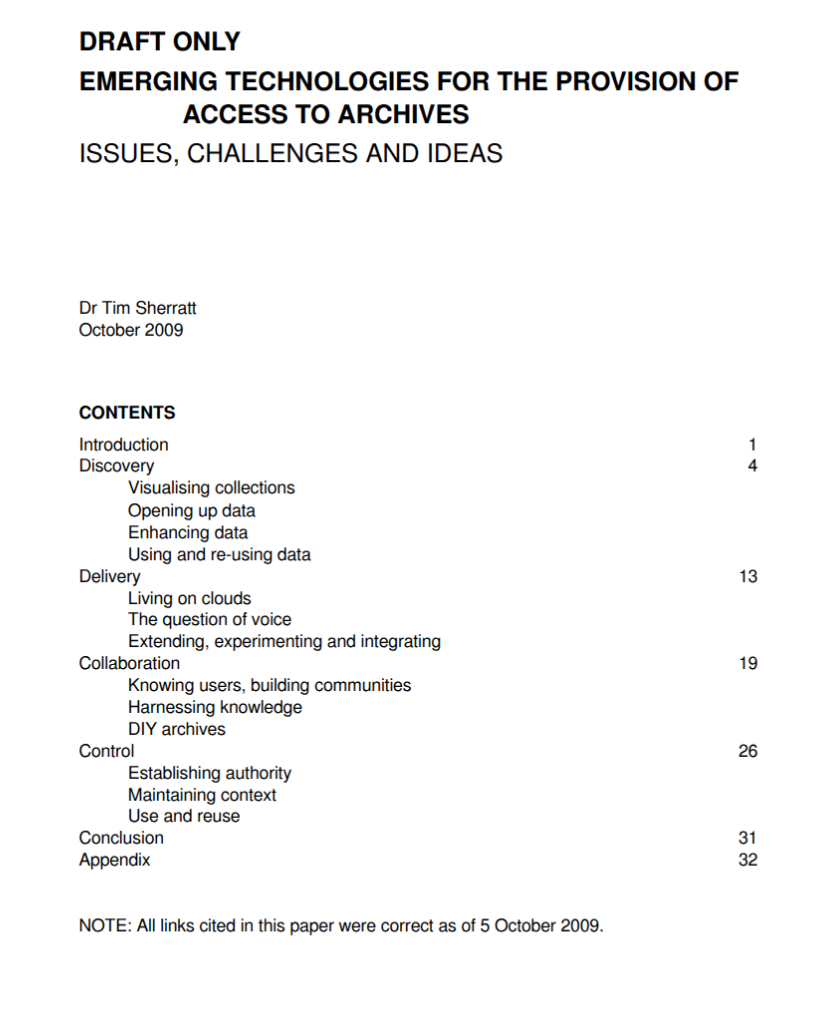
Many of the links are broken, of course, but quite a few of the issues still seem relevant, even if our optimism has faded over the years. In my recent GLAM Lab Futures keynote I suggested we should share and celebrate our own histories as a sort of counter balance to the relentless push of ‘progress’. So in that spirit, here’s one perspective on the future of online archives from 17 years in the past.