The future of the past: GLAM innovation and the responsibilities of history
Keynote presented to the GLAM Labs Futures conference, Edinburgh, 26 June 2026. View the full set of slides.
In 2012, I was lucky enough to be a Harold White Fellow at the National Library of Australia, working with data from digitised newspapers available through the Library’s innovative online service, Trove. I think it was the first time one of the fellowships had been awarded to a digital project.
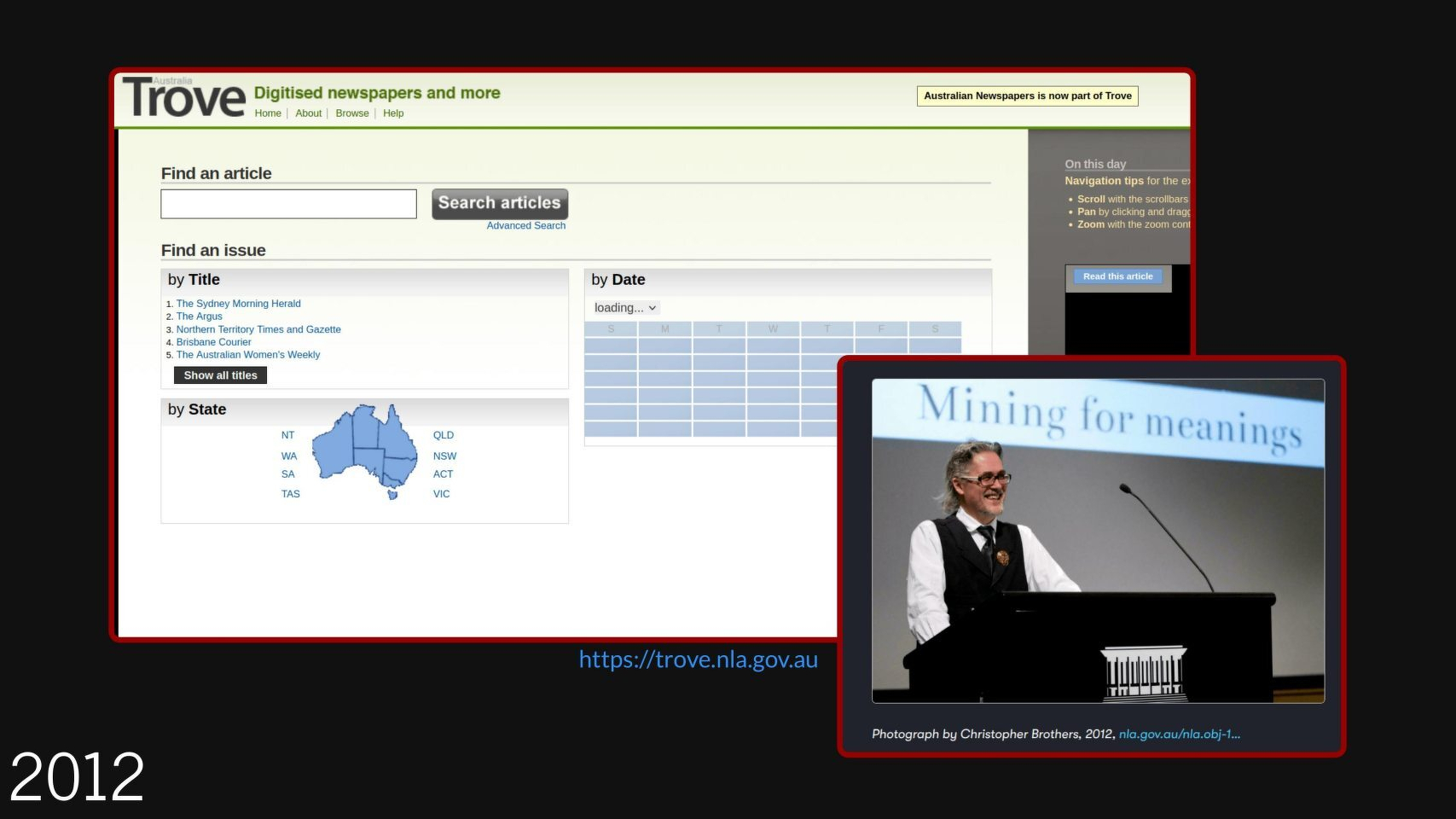
I’d been playing around with Trove data for a couple of years, and had created tools to harvest and visualise searches in the digitised newspapers. There was no API back then, so everything was precariously balanced atop a series of screen scrapers. At one point, I actually pushed my scraper code to Google’s AppEngine to provide an ‘unofficial’ API.
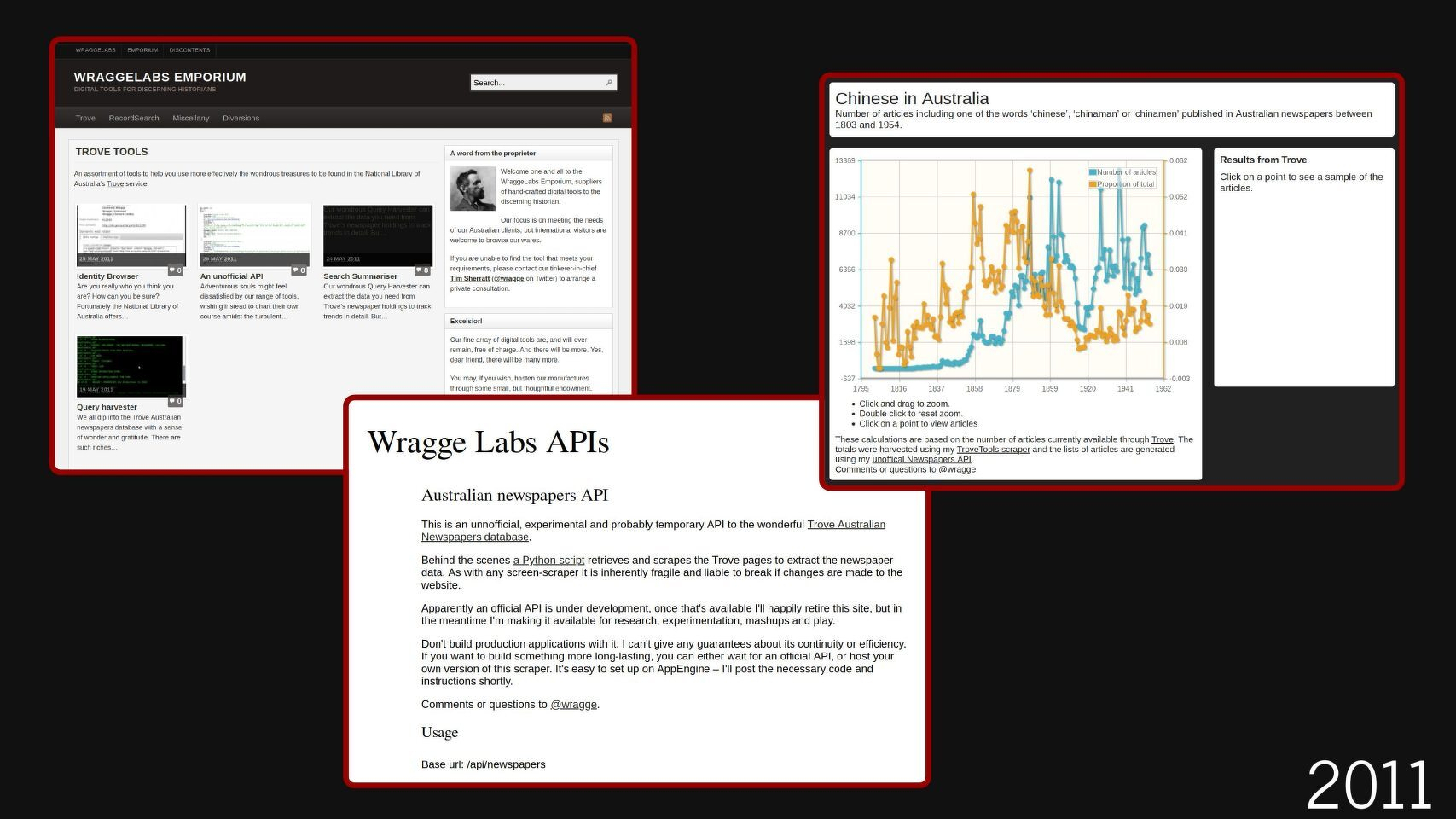
My fellowship project drew on some of the themes of my history PhD, which had examined ideas of progress in 20th century Australia. My plan was to use the newspapers to explore how people over the past 150 years had imagined ‘the future’. I’m sure it’ll surprise no-one here to learn that I spent most of the three months of my fellowship trying to clean up OCR errors – few historical insights were forthcoming.
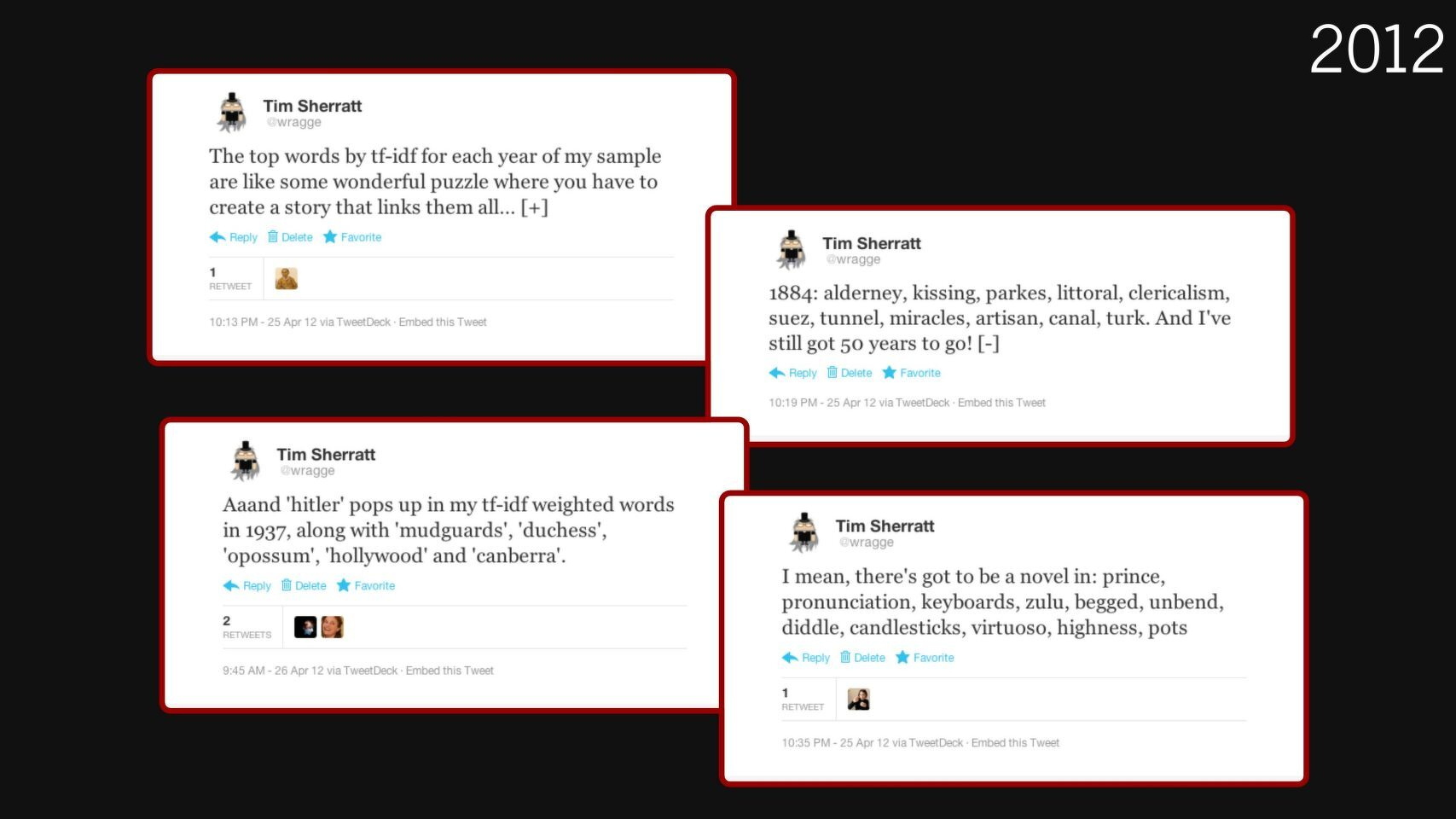
However, there was one experiment that I still enjoy. I harvested a collection of 40,000 articles that included the phrase ‘the future’, and grouped them by year. Then I found the words for each year that had the highest TF-IDF values – so not the most common words, but the words that were most distinctive when compared with the whole collection. I was running this process late at night, and started sharing the results over Twitter. The extracted words seemed evocative, almost poetic – so I decided to make something that people could use to craft their own odd little poems from the dataset.
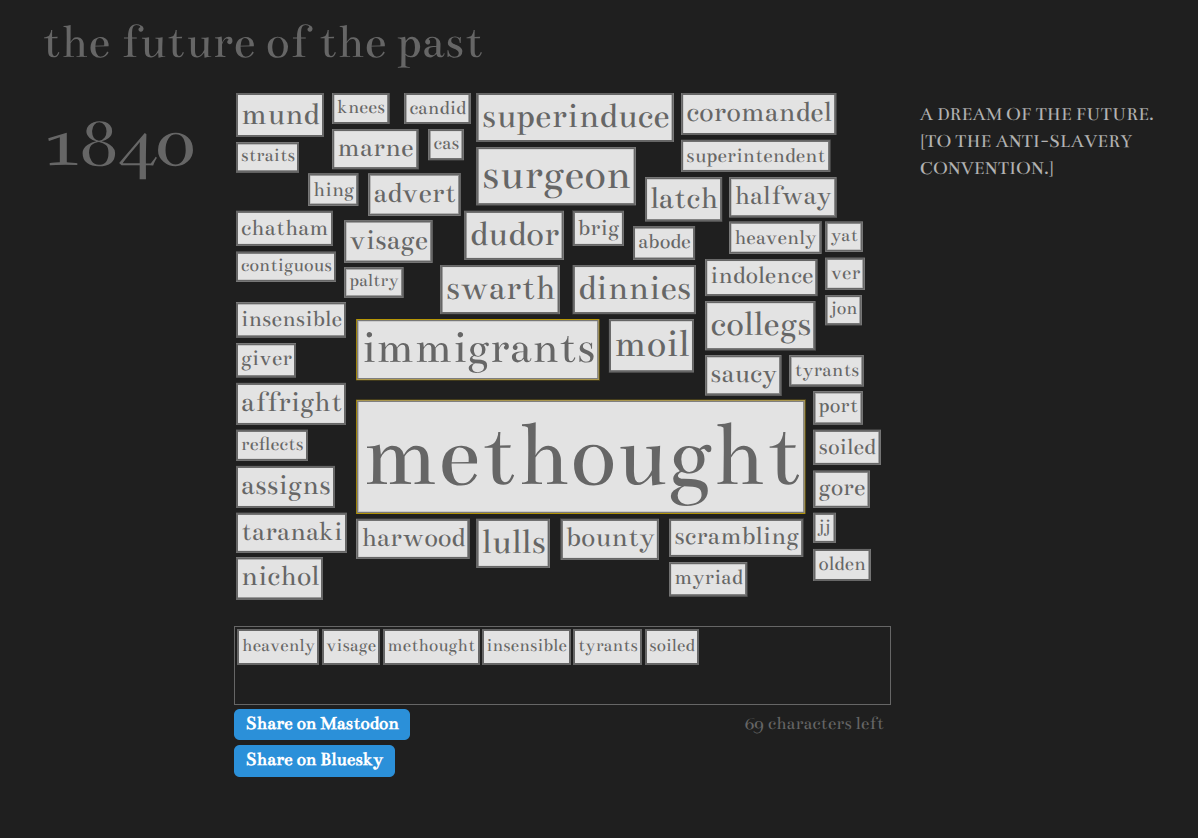
This was ‘The Future of the Past’. The interface was obviously inspired by fridge magnet poetry. You drilled down through randomly selected, TF-IDF weighted words until you reached a year. Then you dragged words around to create your poems and share them on Twitter. It was also a way of exploring the collection. Words were linked to articles, which all linked back to Trove.
Over the years, the application gradually rusted, seized, and fell apart. It was running in Django and MySQL and I think I missed some updates or database migrations. When my webhost stopped supporting Python, getting it working again just seemed too hard.
Last year I was doing some housekeeping, trying to bring a lot of my old apps an experiments together to reduce both the maintenance burden and my cloud hosting bills. I realised I could convert the old app to run in Flask and access its data from SQLite. Of course, Twitter had by then congealed into a slimy hellhole of neo-nazis and transphobes, so I also changed the sharing options to include Mastodon and Bluesky.
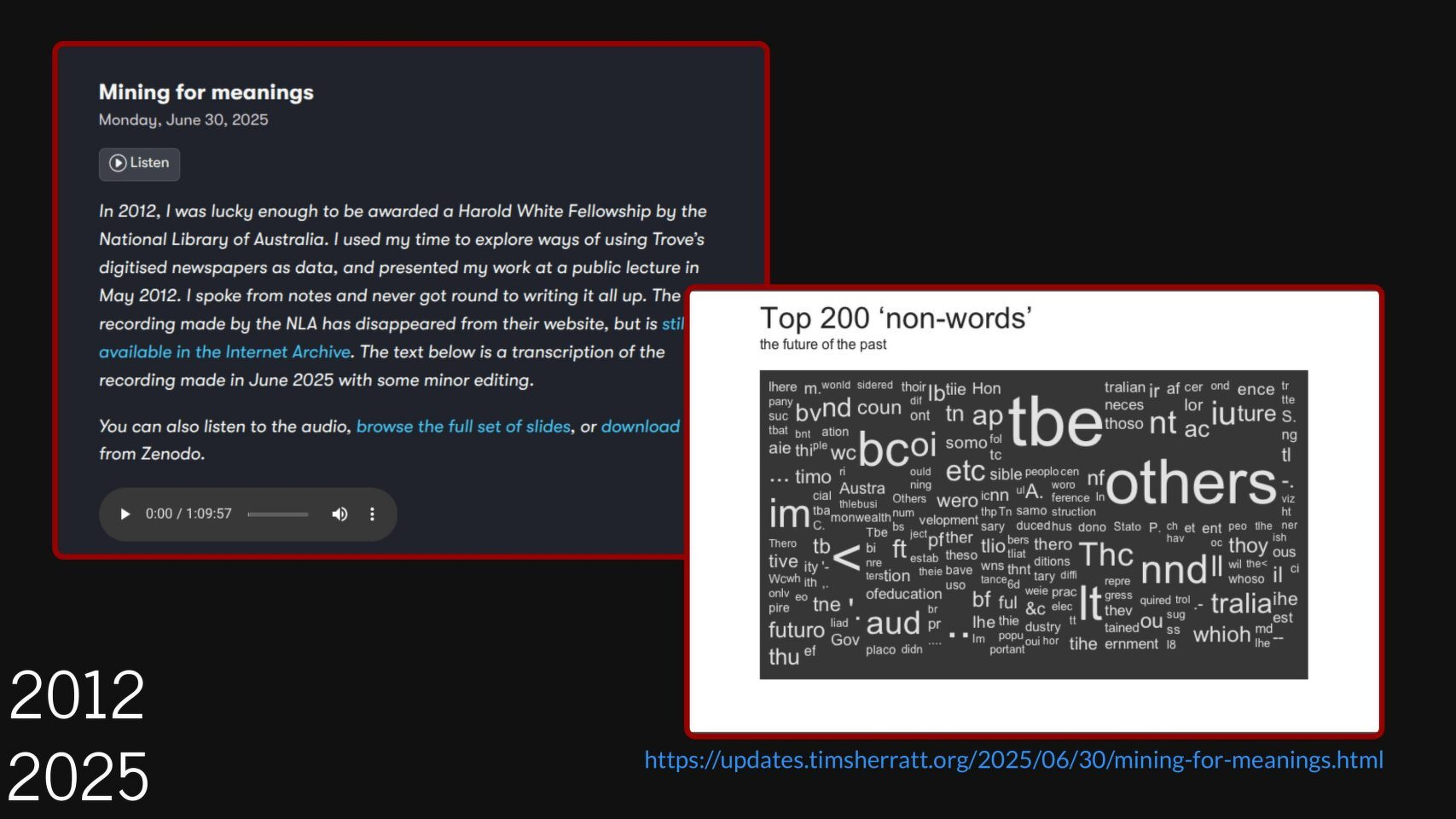
I thought I should also publish my fellowship lecture somewhere to provide a bit of context. The lecture has long since disappeared from the National Library’s website, but I managed to find a recording in the Internet Archive that I could transcribe and pop into Zenodo.
So ‘The Future of the Past’ lives again! An experiment examining how the past imagined the future, itself disappeared into history, until resurrected it in the present to provide a record for the future.
GLAM Labs, and GLAM innovation in general, occupy a complex position with respect to time. We explore how new technologies can be used to mobilise the past in the present. We imagine future audiences, and reconstruct past lives. We think about what’s coming next, but also what needs to be preserved.
In my talk today I want to think a bit about how we navigate time.
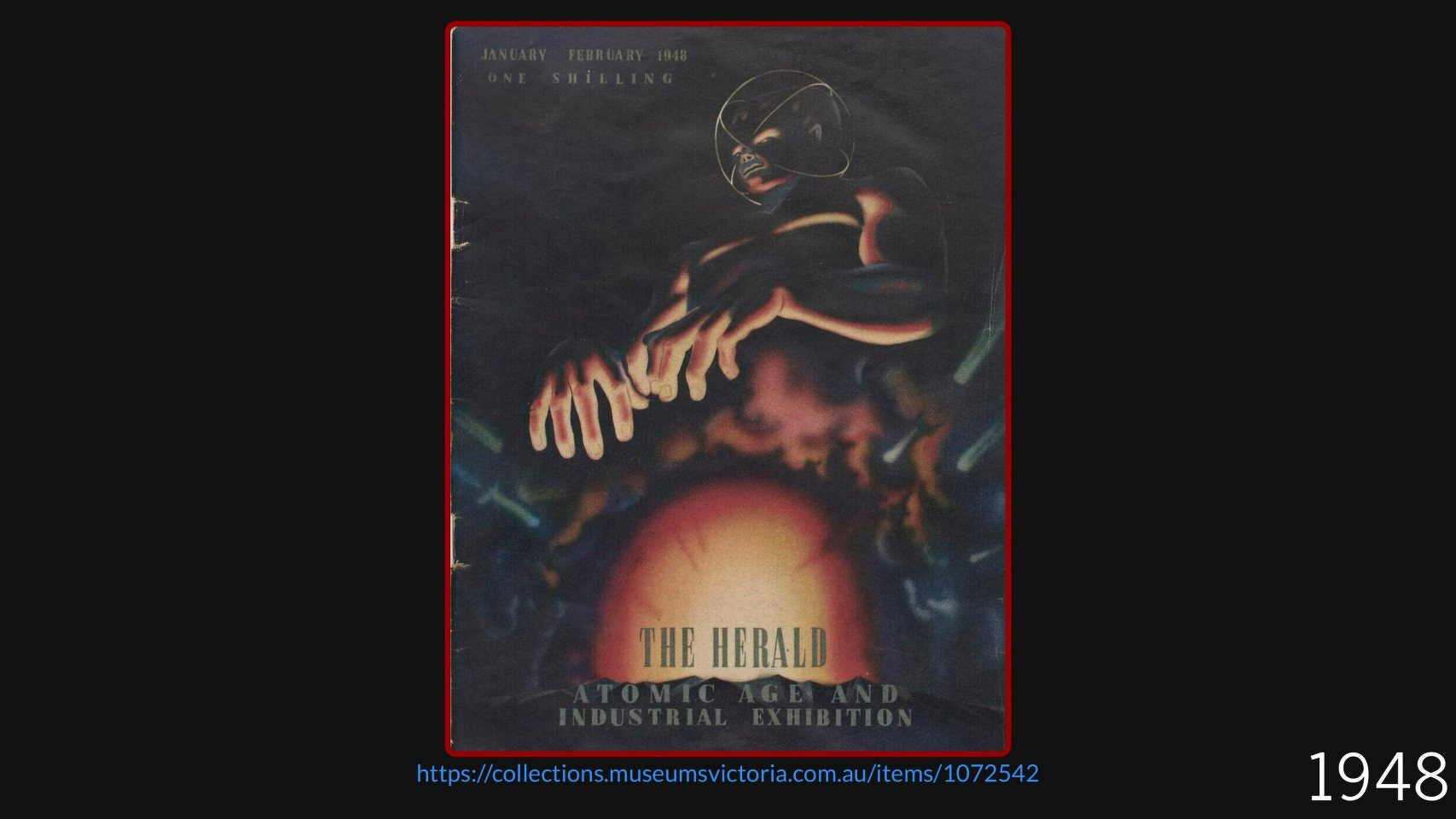
While researching my PhD, I found out that an Atomic Age exhibition toured Australian cities in 1947 and 1948. The exhibition included a diorama that represented the first atomic bomb test in the New Mexico desert. Emerging from the fireball, a mysterious figure loomed over the scientists – the atomic genie had been released and awaited our command. Would we use its powers to foster progress or wreak destruction?
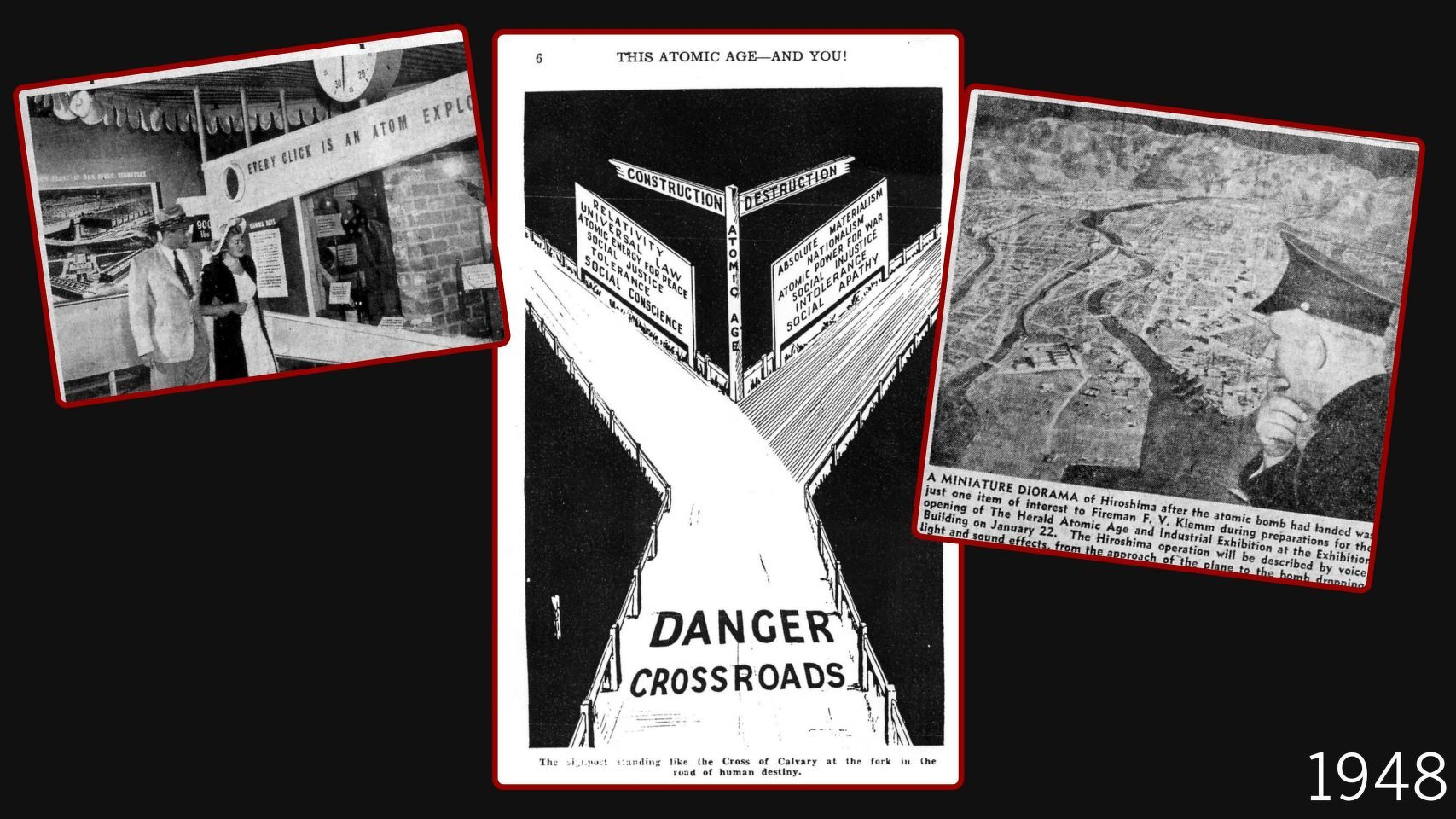
This choice was made even more explicit by a signpost in the middle of the exhibition. ‘Progress’ pointed to a display of the possibilities of atomic energy in industry, while ‘Destruction’ directed visitors to a scale model of Hiroshima with a recorded soundtrack and flashing lights for that authentic atomic annihilation experience. The idea that humankind was at some sort of ‘crossroads’ was a common way of representing the challenges of the atomic age. We had arrived at a critical moment in history, when our decisions would determine the fate of civilisation itself.
So what happened? Did we choose? This was not the first turning point that humankind had faced, nor the last. In 1966, Elizabeth Eisenstein, a historian whose major work focused on the impact of the printing press, wrote about history and our perceptions of time. She argued that linear, episodic structure of ‘history book time’ dumps us at the opening of ‘the most personally significant, densely packed, fact-crowded final chapter’. The past trails off into irrelevance as we confront an unknown future full of unprecedented challenges. We are, she says, ‘destined always to be poised as an adult on the threshold of a new age, where previous experience offers no sure guide’.
The genie is out of the bottle, there’s no turning back.
The question is not whether real crises exist, but whether our perception of time helps or hinders our efforts to address them. We imagine ourselves in an eternal present where the past is closed off, and the future empty. Solutions always lay ahead.
It took a couple of attempts to finally complete my PhD. In between, I worked for the Australian Science Archives Project (ASAP), a small, self-funded organisation attached to the University of Melbourne. Our mission was to preserve and make accessible the history of Australian science, but with limited funds for outreach we had to be a bit creative. In the early 1990s, I started converting finding aids to plain text files and loading them on to FTP and Gopher servers. Then in 1994 we took the leap to a new, exciting online platform – the web.
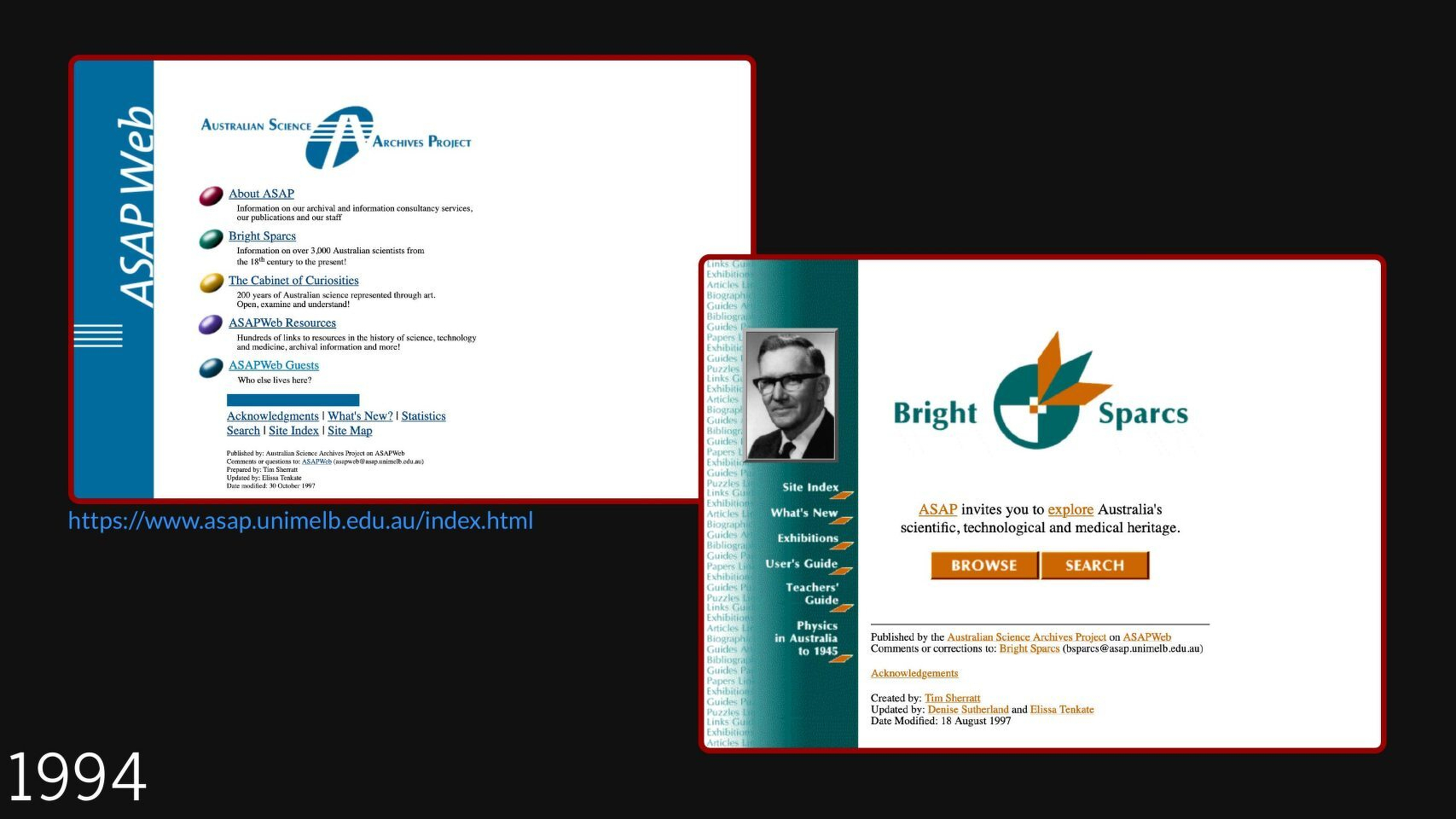
The ASAP website was one of the first Australian history sites on the web, and certainly the first archives site in Australia. As well as newsletters and finding aids, we published a database with information about hundreds of Australian scientists and any related archival holdings – it was originally called Bright SPARCS. In the days before things like MySQL, this meant I had to figure out how to use Visual Basic to convert the Microsoft Access database into what we would now call a ‘static’ site – lots and lots of little HTML files.
After my second, successful PhD attempt, and some time as a postdoc researching the history of meteorology, I ended up back in the archives world at the National Archives of Australia (NAA). I was a member of the small web content team, and in 2008 I had an idea for a web application to accompany a new physical exhibition on Australia’s involvement in World War I.
For a non-Australian audience, I feel I need to explain at this point that World War I is still a big deal in Australia. The qualities of Australia’s fighting men – the Anzacs – were mythologised and woven into a particular vision of national identity that still wields considerable political and cultural power. The exhibition I worked on was designed to highlight the digitisation of 376,000 WWI service records, funded through a special allocation from the federal government, and presented as ‘a gift to the nation’.
The archivists who described the service records had the foresight to embed some structured data, such as places of birth and enlistment, in the file titles. So I suggested we extract the place names, geolocate them, and create a map interface for users to explore the records by location. Sounds pretty standard these days, but there was nothing quite like it at the time. We also collected photos and stories from users by setting up a ‘scrapbook’ in Tumblr and linking it to the map interface through the Tumblr API.
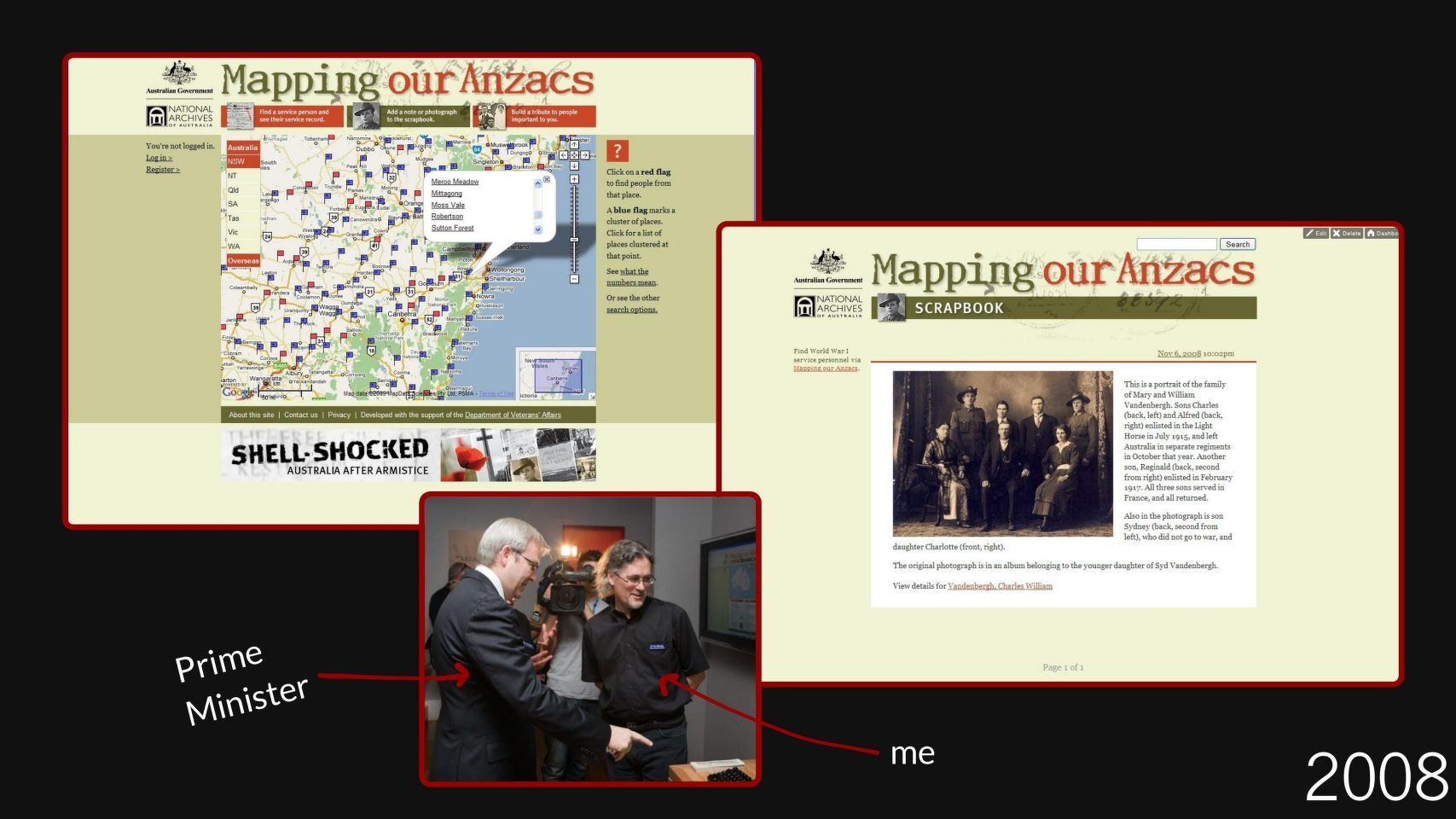
The site, named ‘Mapping Our Anzacs’ (not the choice of the development team), was popular with users who added more than 1,000 scrapbook posts in the first six months. It was also popular with politicians and bureaucrats who trumpeted it as an example of how ‘web 2.0’ might transform government services through digital innovation and online engagement.
It lasted about 6 years in its original form. In 2014, the content was rolled into a new site called ‘Discovering Anzacs’ with some additional records. That site was suddenly decommissioned in 2023, breaking all the links that people had made to individual records, and discarding all their contributions. The media release announcing the change pointed people to an ‘archived version’ in the Australian Web Archive. It was headed: ‘Discovering Anzacs website decommissioned, making way for innovative new digital experiences’. These new digital experiences have yet to emerge.
The past is closed off and the future is empty. The media release made it seem as if the change was inevitable – technology had simply moved on. There’s no escaping the fact that long-term maintenance is hard, but there are always choices to be made. Let’s not simply shrug and point to the pace of change as a way of avoiding responsibility.
Bright Sparcs, on the other hand, is still online. The original site is archived and its urls preserved. The content and identifiers have been rolled forward into the ‘Encyclopedia of Australian Science and Innovation’. After 32 years, it still works. That’s mainly due to the efforts of Gavan McCarthy, the former director of ASAP, who created the original database in the 1980s and continues to maintain it. There are always choices to be made.
In 2009, I was asked to reflect on ‘Mapping Our Anzacs’ for a book edited by Kate Theimer on significance of ‘web 2.0’ for archives and local collections. When asked what advice I’d give to an organisation venturing down this path I suggested:
Start experimenting. The technology is developing so rapidly that if you spend 12 months planning a project it’s likely to be out-of-date even before you start. New web services and data sources are becoming available every day.
Obviously, I’m still a strong believer in the value of experimentation. But I look at the sentence on the speed of change now and think it could have come from the mouth of some corporate AI shill. Quick, don’t be left behind! You can’t afford to wait! Sign up now!
Maybe I’m getting old and slow, but I’m more inclined now to think about the range of timescales across which we work – about the traces we leave behind, as well as the short term impacts. If I was starting ‘Mapping Our Anzacs’ again, I think I’d be trying to make sure all the geolocated metadata was properly versioned and saved in an open repository. Similarly, I’d create an independent backup of the scrapbook posts. I was focused on meeting the deadline and getting it to work, but I also should’ve been thinking about what happens when the institution pulls the plug.
A lot of important work has been done since then on digital preservation, the value and ethics of maintenance, and planning for the death of projects. But I also wonder what the fate of our digital projects tells us about our orientation in time. For the NAA, ‘Mapping Our Anzacs’ was a burden inherited from a near-forgotten past. For me it was an example of what you can achieve on a tiny budget by hooking together existing services and opening yourself to the public. Even after 18 years, it still seems to address the future.
The work we do is embedded within its own histories – personal, institutional, technological. We find in those histories points of meaning and connection that help us make sense of where we are. I’m sure we can all point to projects or people that jolted our understanding of what was possible and sent us careening down new pathways. None of us start from scratch. For me, the period between 2007 and 2012 really helped to define what I do and why.
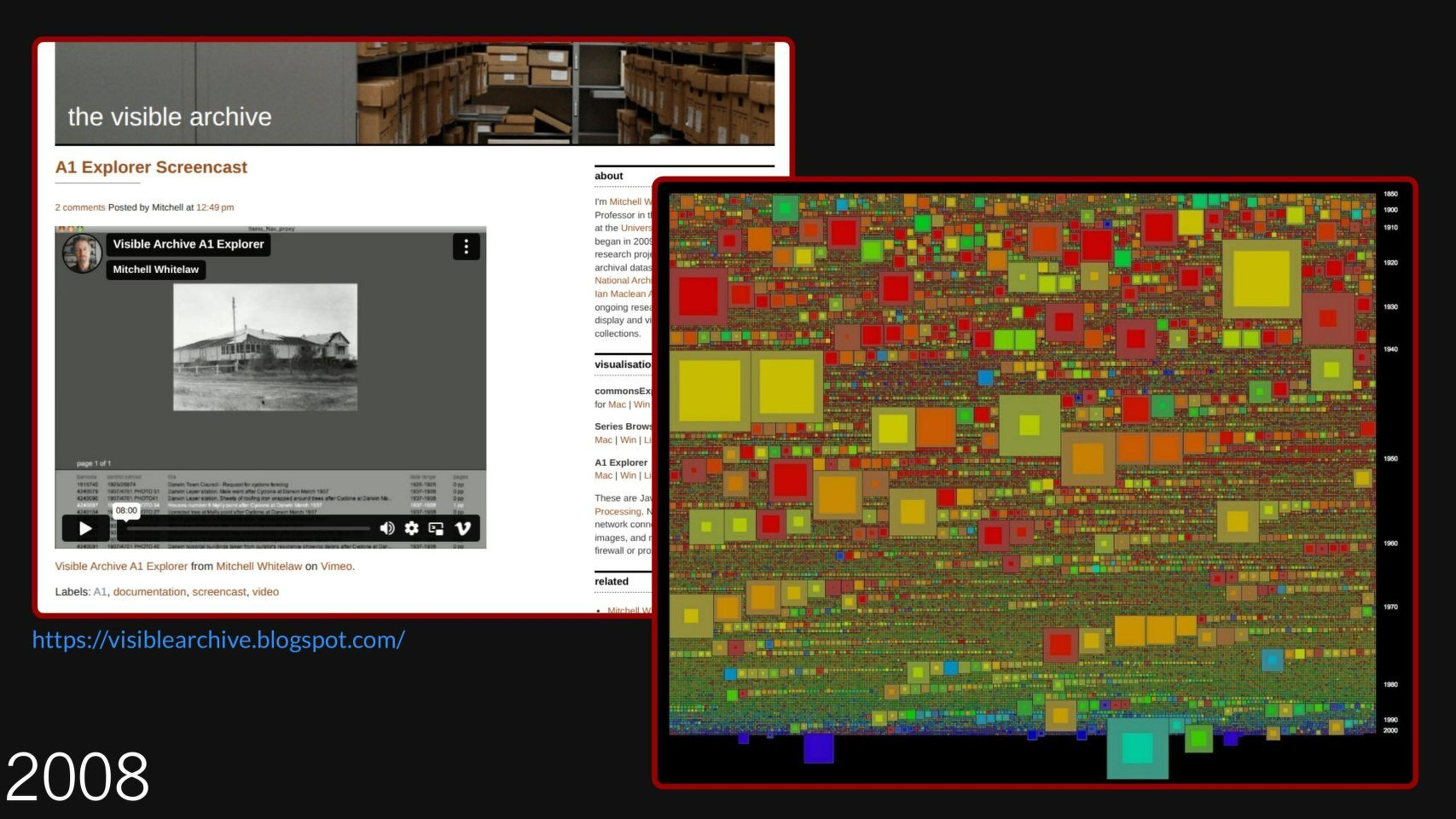
In 2008, Mitchell Whitelaw was granted a fellowship by the National Archives of Australia to undertake his ‘Visible Archive’ project. It was the first in a series of GLAM collection visualisation projects through which Mitchell developed his oft-cited concept of ‘generous interfaces’. I helped Mitchell wrangle some of the NAA data, and his work inspired me to look at collections as a whole, rather than as a series of individual items.
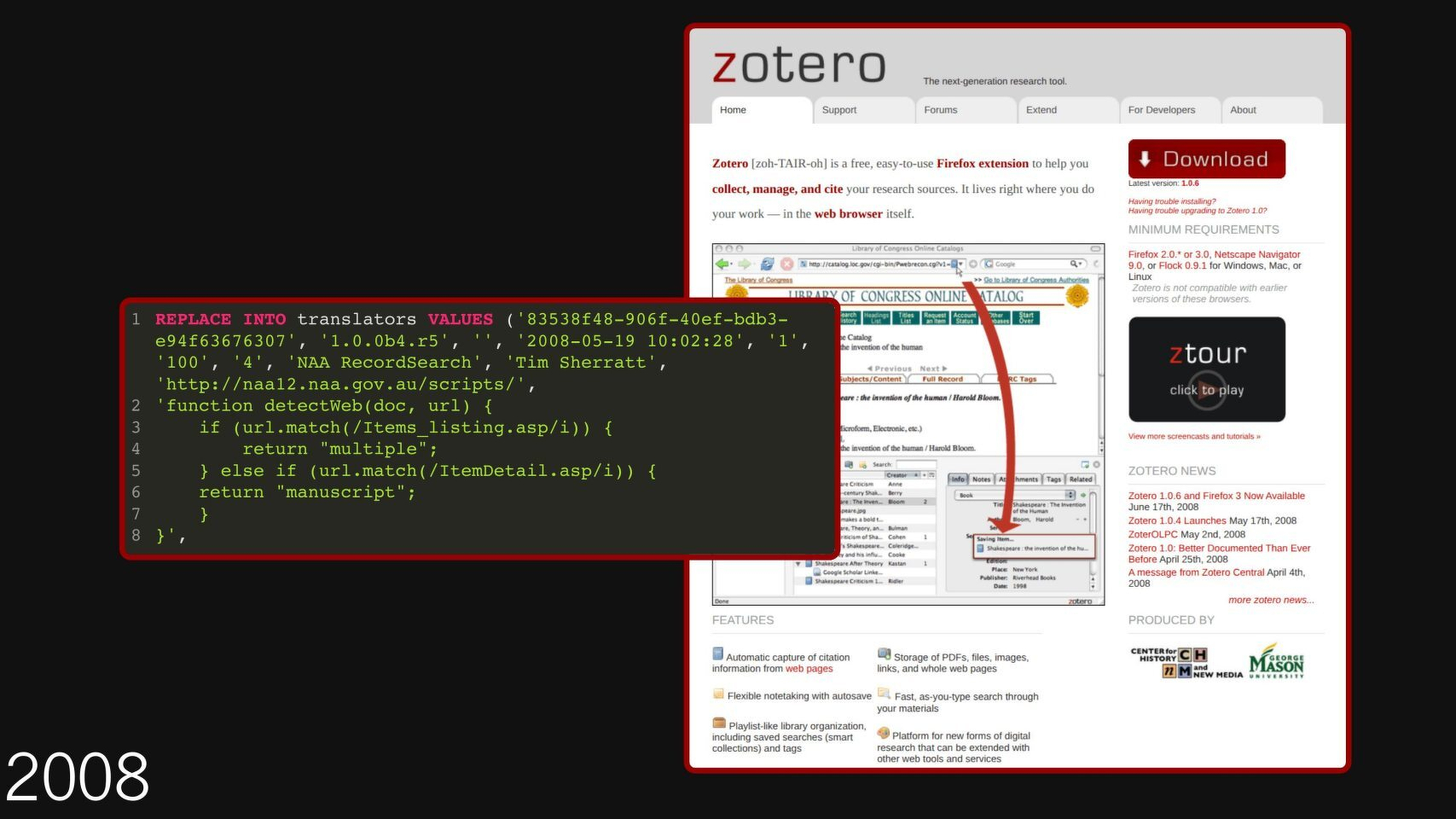
Also in 2008, I created my first Zotero translator for the National Archives online database, RecordSearch. It made me think about what happens when we liberate collection data from web interfaces. Zotero, along with Omeka, was the product of the Center for History and New Media at George Mason University – a site that bubbled with GLAM-related enthusiasm and encouraged us to embrace the constructive power of hacking.
In 2009, I visited CHNM to present ‘Mapping Our Anzacs’ at the American Association for History and Computing conference. On the same trip I spoke at the New York Public Library, which had started pushing out a series of groundbreaking digital projects, like ‘Map Warper,’ ‘Building Inspector’, and ‘What’s on the menu?’.
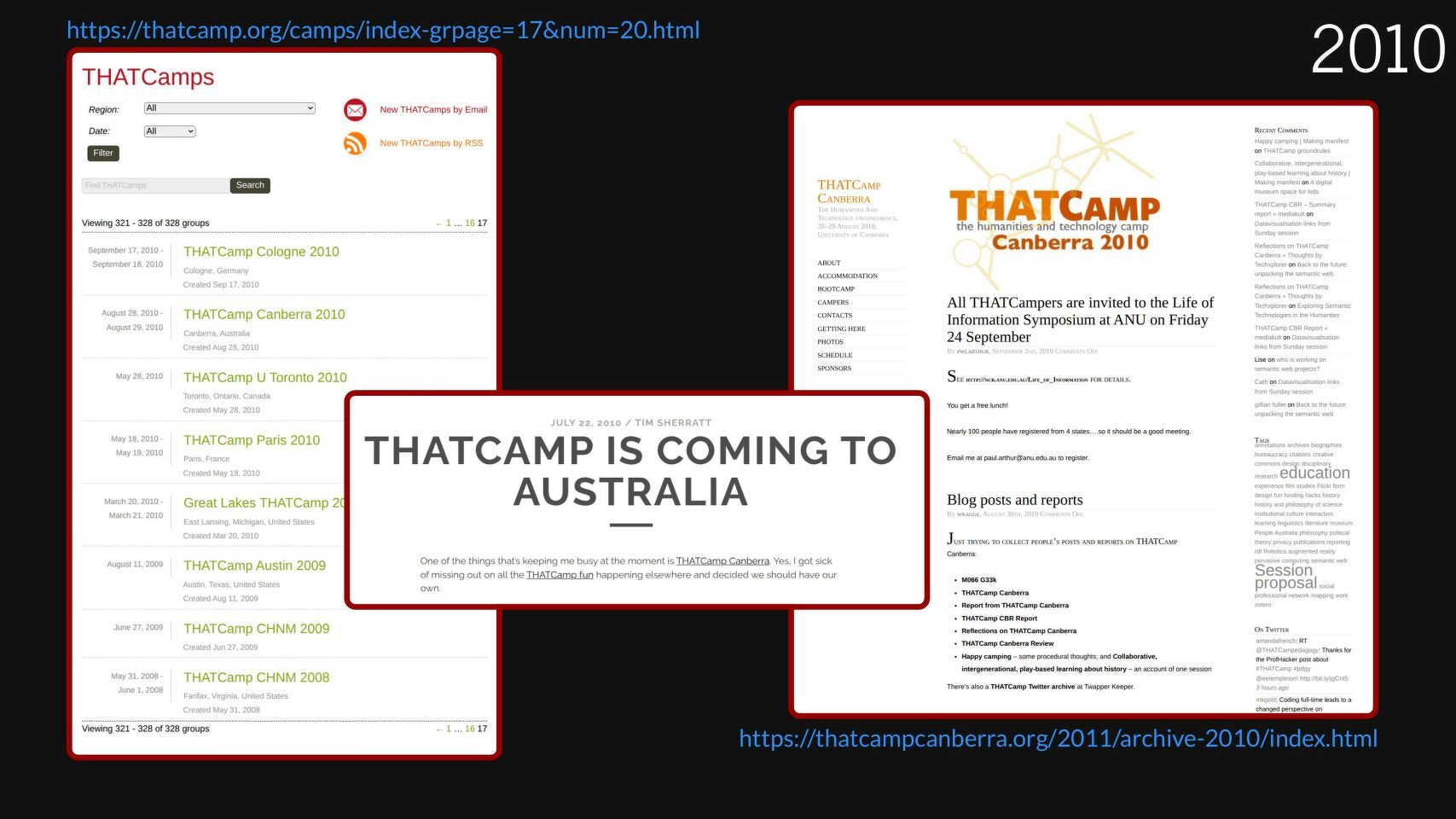
People weren’t just experimenting with code, they were building new structures to enlarge the space and meaning of innovation. CHNM gave us THATCamp, a series of DIY unconferences that connected Digital Humanities (DH) and GLAM practitioners across institutional and disciplinary boundaries. Sick of watching events from afar, I organised THATCamp Canberra in 2010 – it was probably the most fulfilling, and exhausting, thing I’ve ever done. And if you want to know what we discussed in 2010, or in the 2011 and 2014 sequels, you can – because I’ve archived the sites and continue to pay the hosting bills.
A few months after THATCamp Canberra, we were visited by Bethany Nowviskie, the Director of the Scholars' Lab in the University of Virginia Library. Bethany challenged us all to think about the institutional, human, and political contexts of DH and GLAM innovation. In her 2011 talk, ‘A skunk in the library’, Bethany described the Scholars' Lab as
a conscious experiment: an experiment in modeling effective relationships of research-and-development work by librarians & library IT both to the digital humanities as an exciting community of practice, & to our own future – the future of libraries within a scholarly communications ecosystem experiencing rapid reconfiguration.
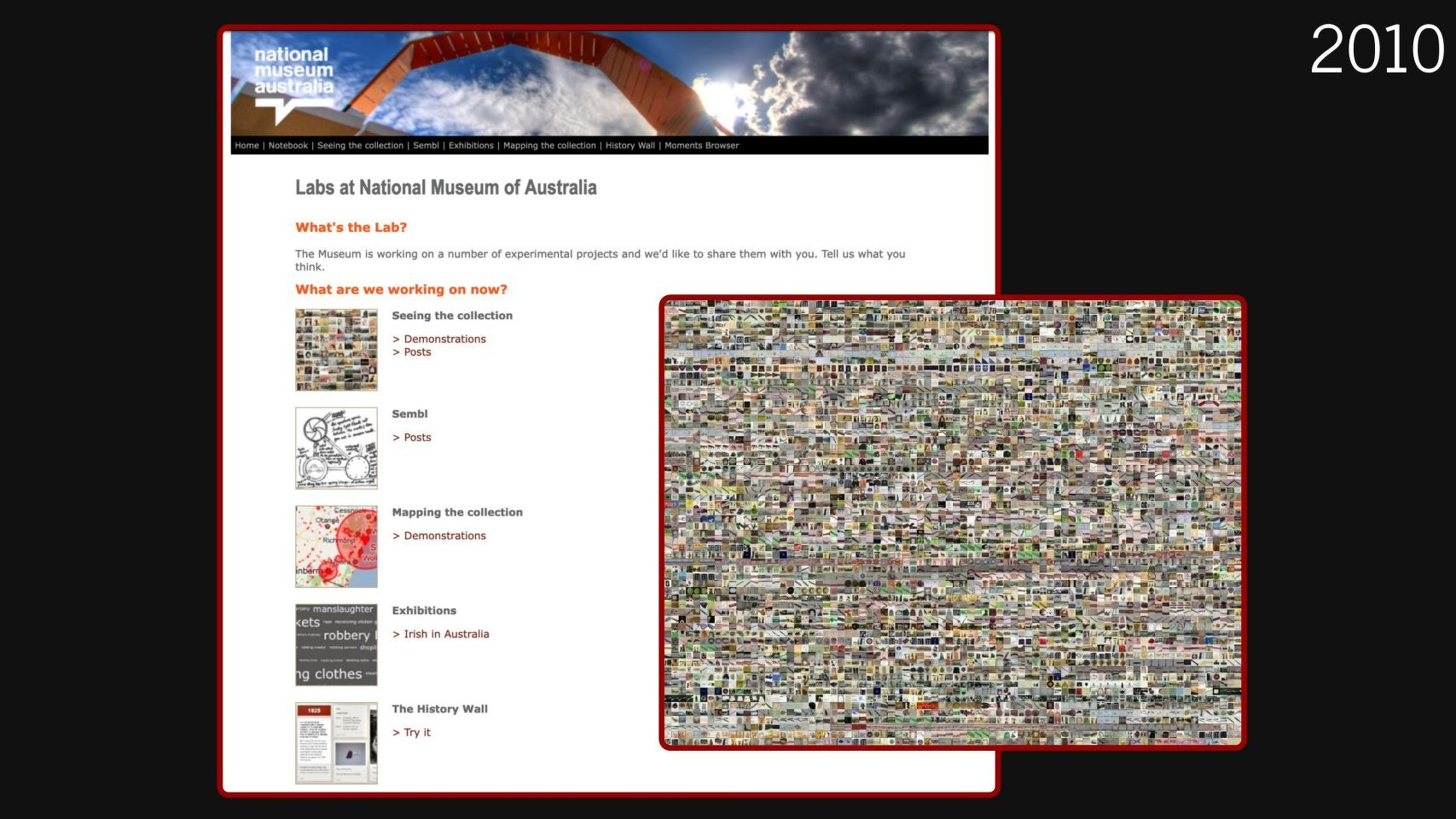
By 2010, I’d left the Archives and was working part-time at the National Museum of Australia, where we created our own under-the-radar, skunky GLAM Lab.
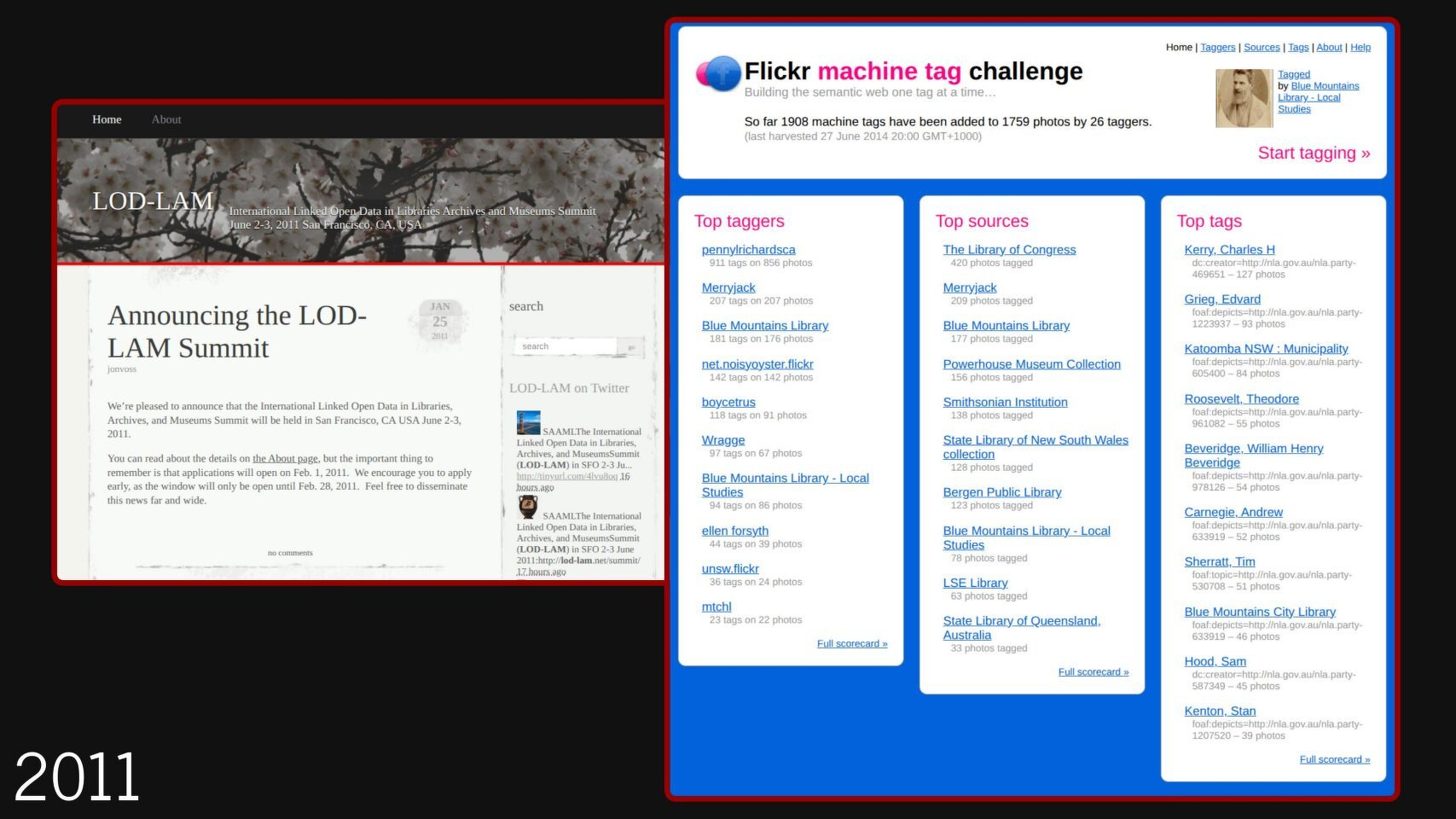
There were also new ways to play around with data. GLAM institutions had started using the Flickr Commons to share their image collections, and Flickr had an API that could be used to extract data and make new connections. One of my early experiments was the Flickr Machine Tag Challenge, which encouraged people to annotate photos with machine-readable identifiers for subjects or creators. This put me in touch others exploring the potential of Linked Open Data, and John Voss invited me to be part of the first LOD-LAM summit in San Francisco in 2011.
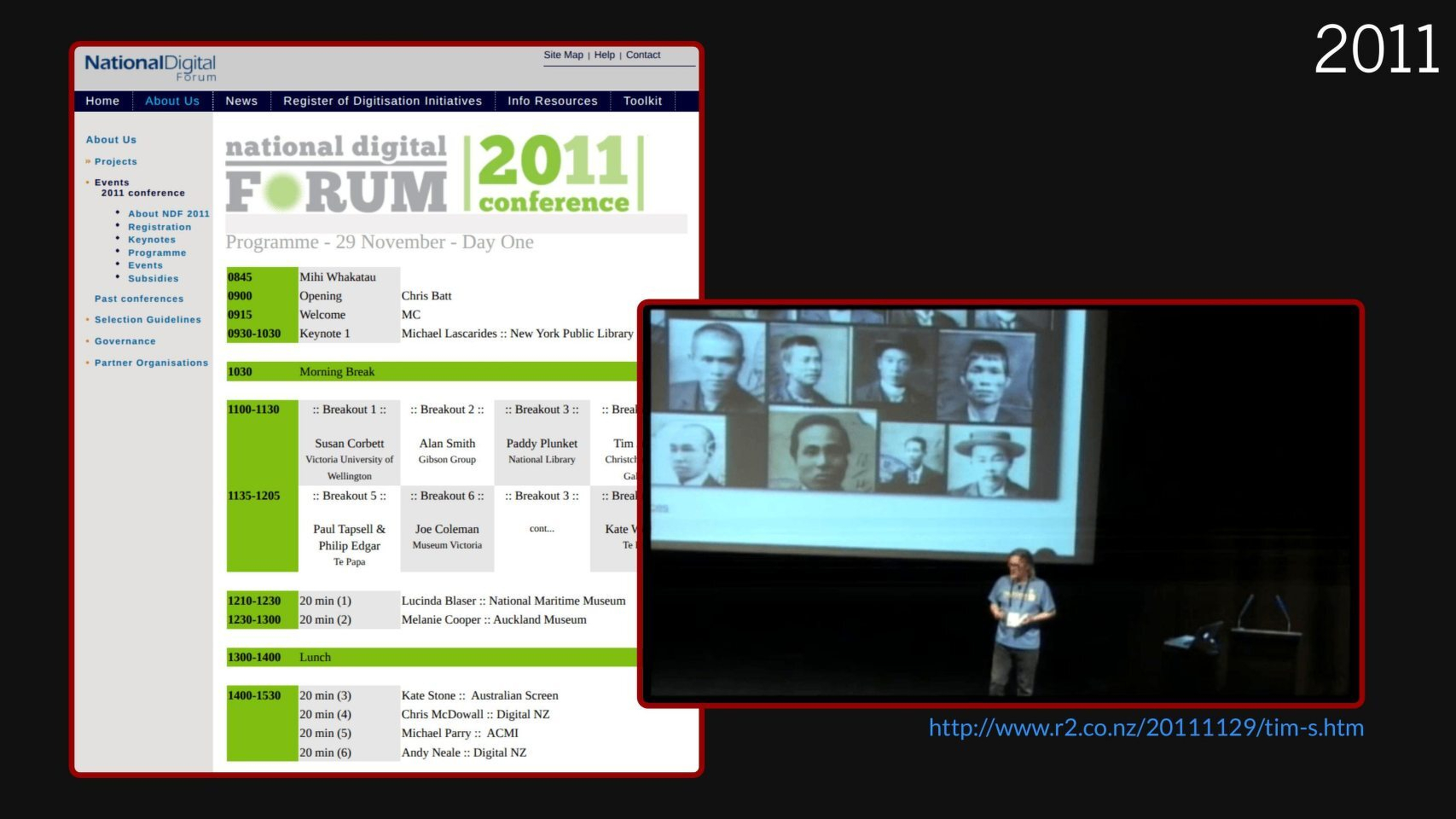
Communities developed, online and in-person, to share ideas and enthusiasm. In 2011, I popped across to New Zealand for my first experience of the National Digital Forum. It was full of GLAM people doing cool digital stuff, and they were all so welcoming and generous. It felt liking coming home. The keynote speakers that year included Mitchell Whitelaw on ‘generous interfaces’, and Michael Lascarides on digital innovation at the NYPL.
The point of these potted histories isn’t to invoke nostalgia, or suggest that some magic has been lost. There’s no lessons to be learned. History is always a conversation between past and present. What might in some respects seem to be a positive story of my growth and development, is also a catalogue of my failings – the discomfort I felt in large institutions, my tendency to self-sabotage, my impatience with administration.
And not all these stories had happy endings. I created the Zotero translator for the National Archives database in my own time. When I released it, an alarmed email was circulated amongst the senior management titled ‘What has Tim done to Recordsearch?’. While ‘Mapping our Anzacs’ was a great success, the web content team that created it was seen as a problem. One senior manager thought we had too many PhDs. Our positions were redefined, and our roles limited to cutting and pasting content that others had created into the content management system. We all left.
I’m sure many of you have similar war stories. We’ve all seen GLAM Labs come and go – projects die, initiatives falter. But that’s all the more reason why we should remember.
History provides ballast to keep us upright amidst the storms. We can draw on the strength of past achievements, reflect on failures, marshal precedents to confront new challenges. History gives us the weight and resolve to stand against the assumption of inevitability, the fetishistic power of the ‘new’ – to ask the questions that need to be asked.
When the LinkedIn bros warn that GLAM organisations are being left behind by the latest AI developments, I think about how long we’ve been working with technologies like machine learning and computer vision. Dipping again into my own history, I remember 2008, when the Powerhouse Museum started using natural language processing to automatically tag collection items. I remember 2010, when Paul Hagon from the National Library of Australia gave a conference paper on using facial detection to explore image collections.
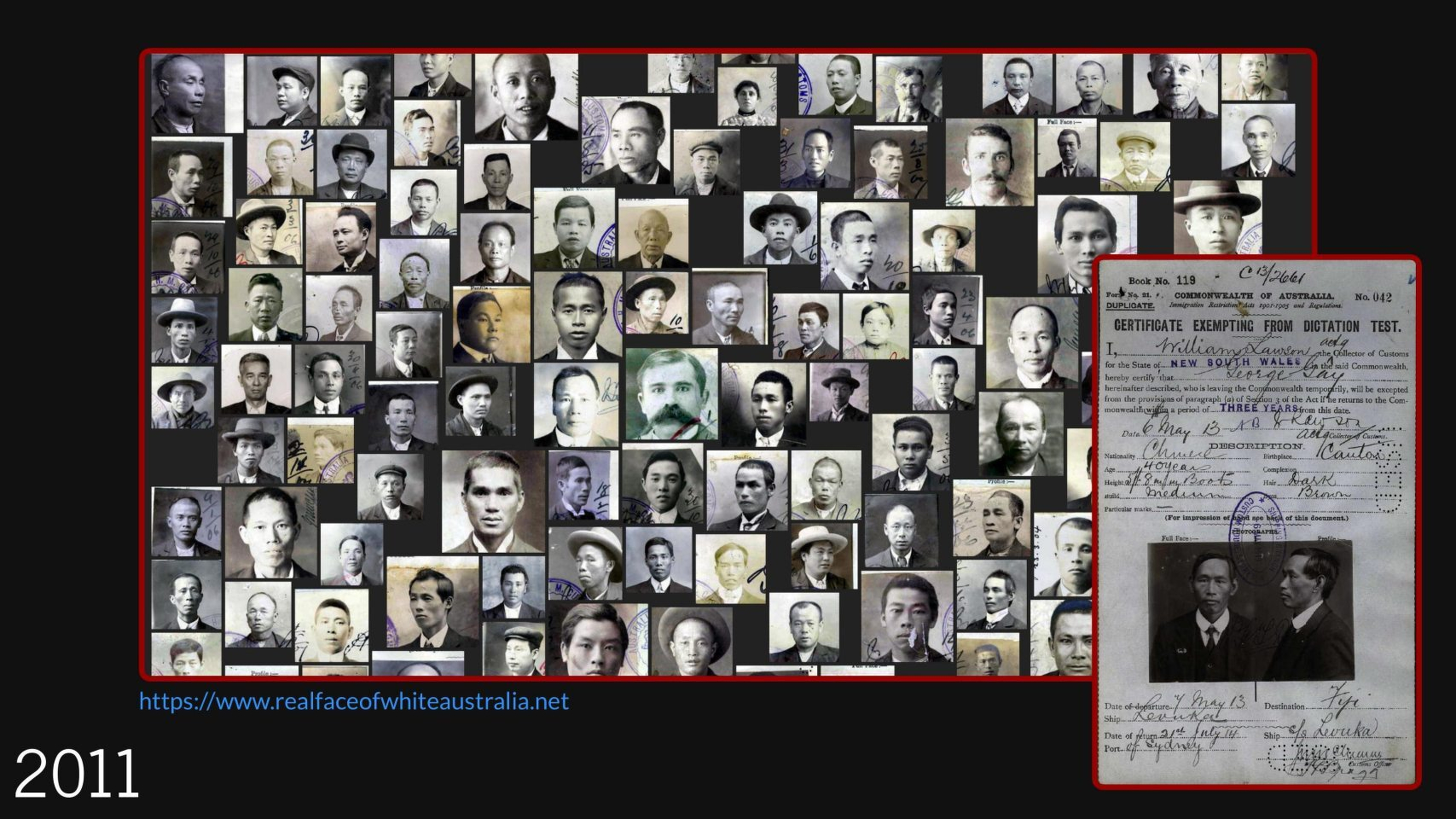
In 2011, Paul’s work inspired Kate Bagnall and me to use facial detection to find the people inside the records of Australia’s racist migration policies and expose ‘The Real Face of White Australia’.
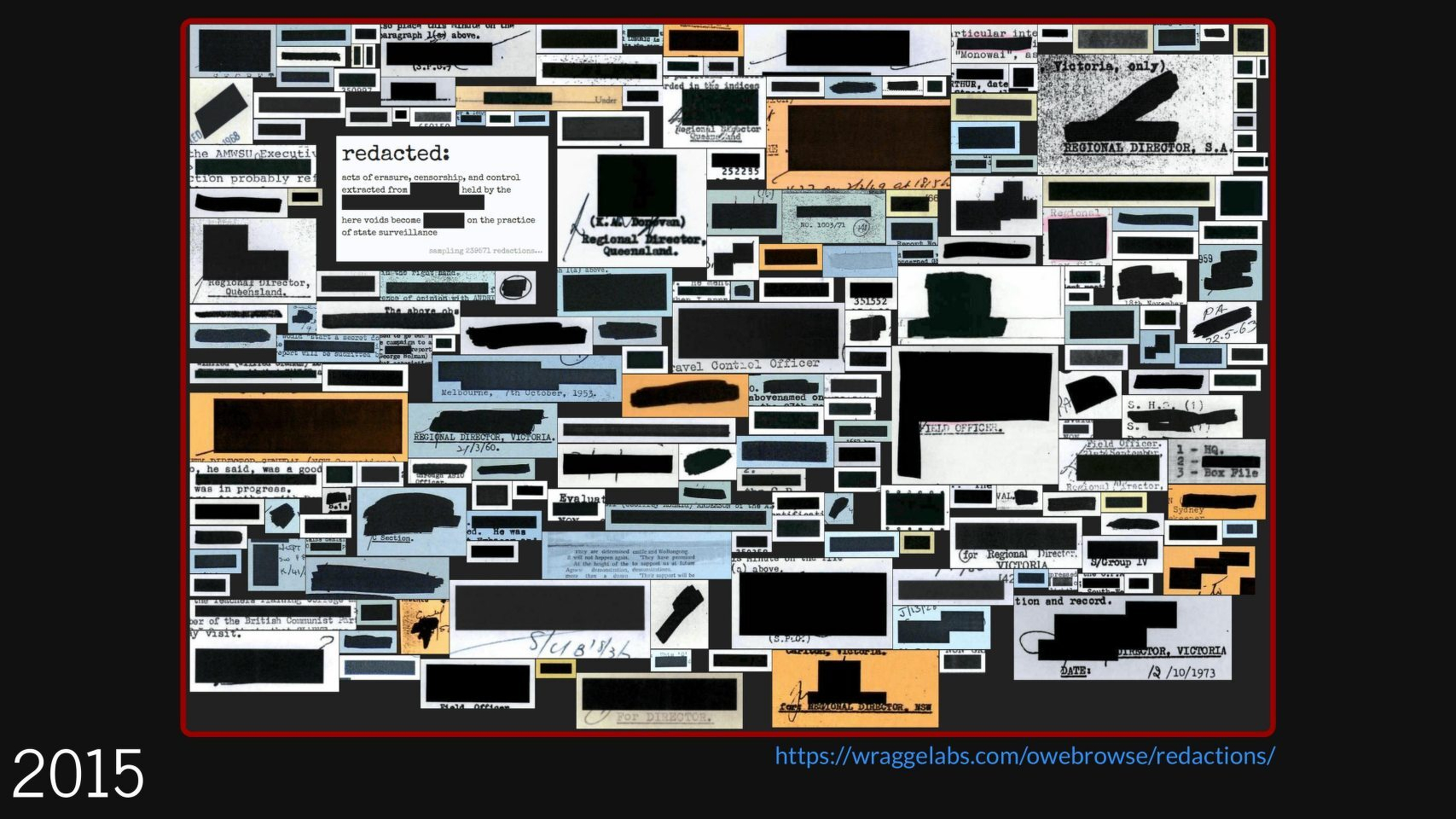
A few years later, I started fiddling around with object detection to extract thousands of redactions from the surveillance files of Australia’s internal security organisation.
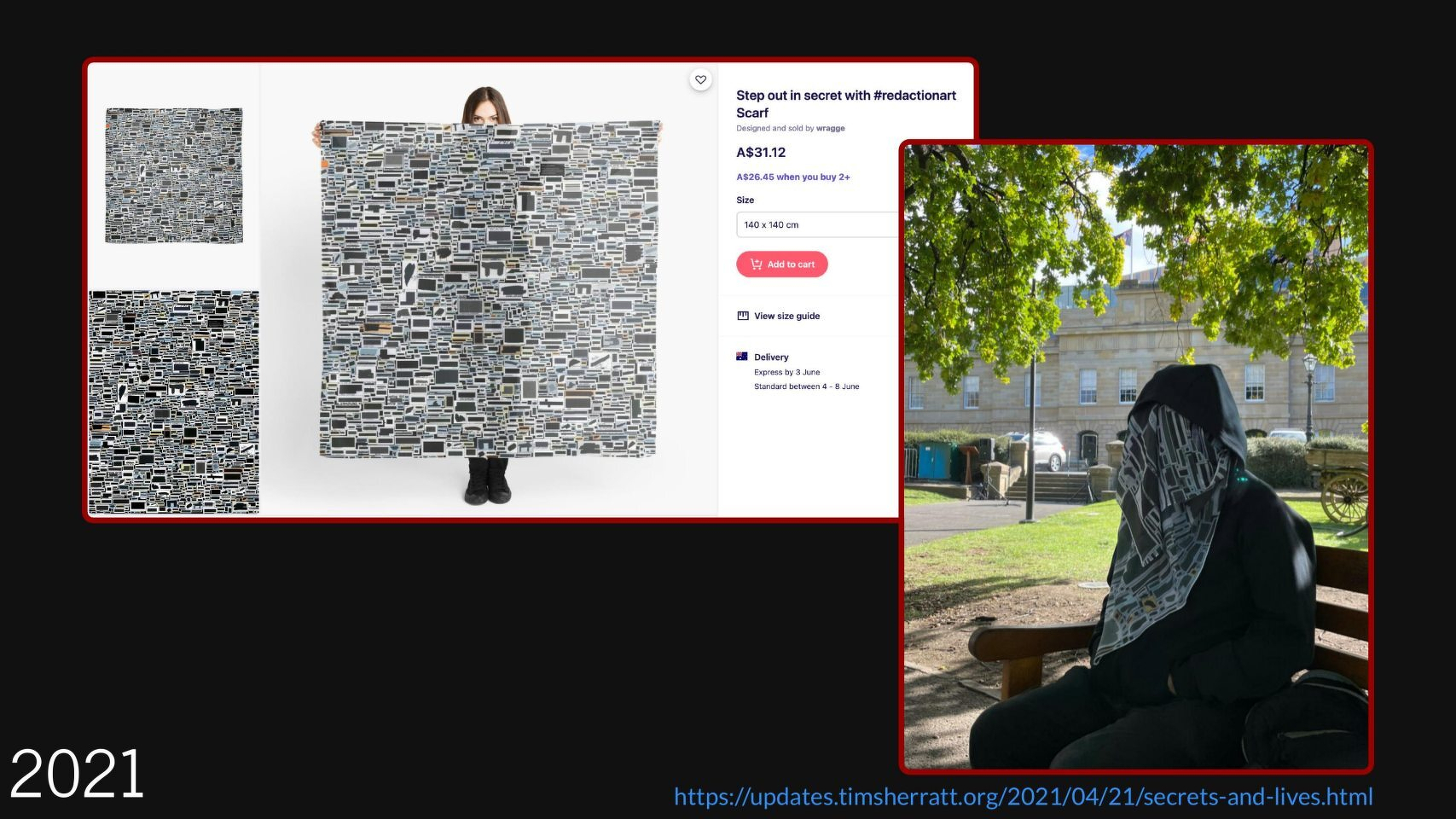
And if you want to erase yourself from history, try wrapping yourself in one of my #redactionart scarves, made from 100% recycled redactions.
Of course the technologies have changed, but there are continuities as well. The simplicity of turning points rarely withstands the scrutiny of history. Understanding is born from our struggle to reconcile the fact that everything is new, and yet nothing is new.
I spent a lot of time during my PhD destroying my eyesight with microfilm readers – trawling through newspapers year by year, decade by decade. If I’d started my research in the post-Trove era, my experience would have been very different. I wonder whether the questions I asked would have changed as well.
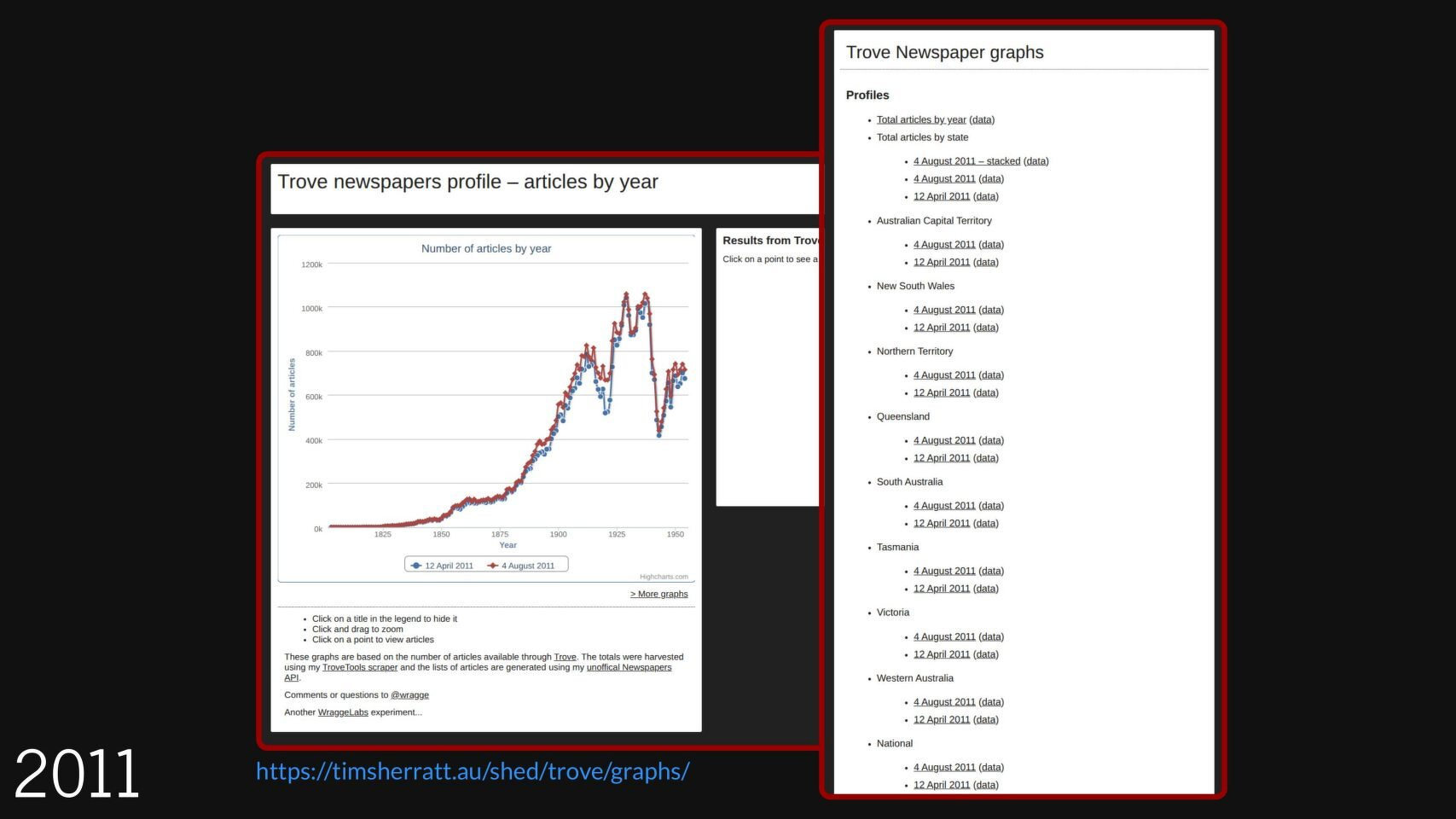
But Trove itself isn’t fixed in time, it has its own history that runs parallel to the explorations of its users. By a sort of happy accident, some of my early visualisations captured the state of the newspaper corpus as it was in 2011.
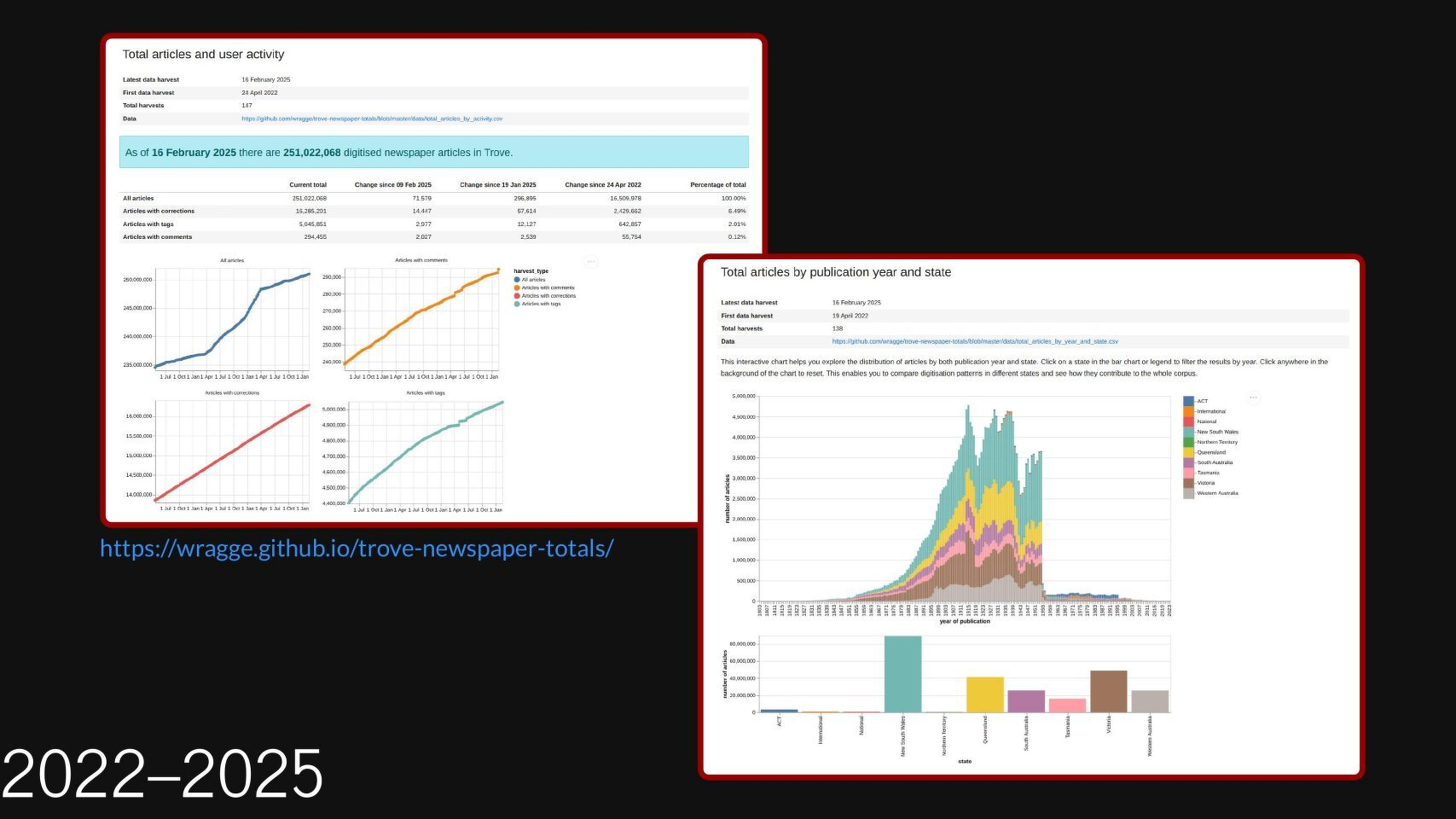
I repeated the same analysis at irregular intervals until 2022, when I set up an automated process in GitHub that captured weekly changes and displayed them on a dashboard. That continued until February 2025 when the National Library of Australia cancelled my API access.
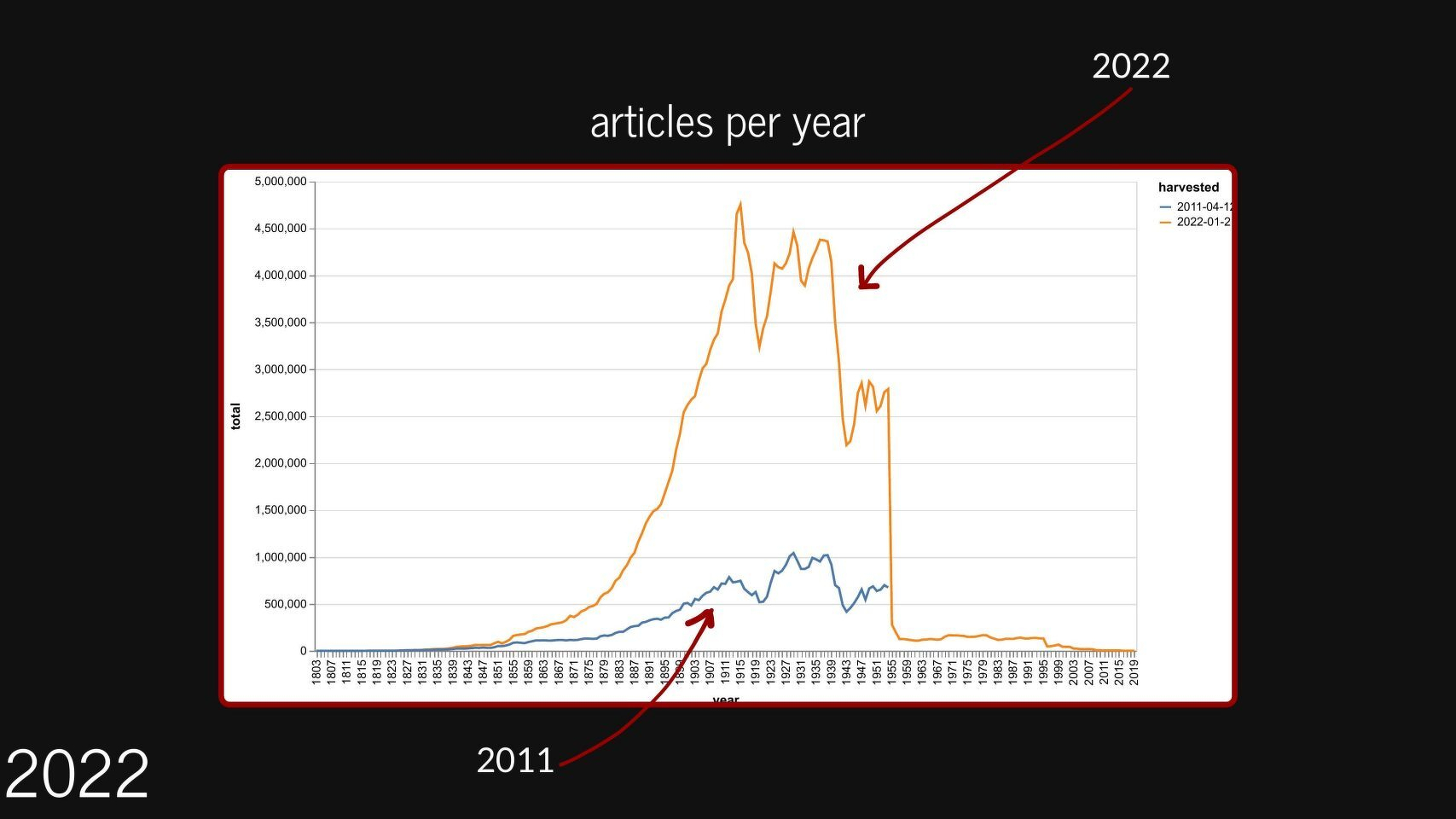
I’ve often used these visualisations to encourage people to think about the way the online collections are constructed – about how their search results are affected by things like institutional policy, legislation, funding, and technology. Sometimes I’d compare visualisations from 2011 and 2022 and ask them how their research might have been different according to their own location in time.
There’s been a lot of useful thinking around how we measure the value and impact of digital resources in the GLAM sector – including detailed frameworks like Europeana’s Impact Playbook and Adrian Kingston’s Audience Impact Model. But the windows through which we observe impact are still pretty small.
I’m thinking of a researcher in 20 or 30 ‘years time who wants to understand how digital collections, like Trove, changed the practice of history – changed the types of questions we could ask about the past. They could mine the historical literature, extracting citations and analysing data use, but that only gives half of the picture. How can they examine the literature in the context of the digital collections as they were when the original research was conducted? Online collections grow as more material is digitised. Improvements in OCR make more items findable. Interface updates can affect access to the underlying data. How do we capture these sorts of changes?
This history – the history of digitisation, metadata enrichment, interface design, prototype construction, dataset documentation, tool development – asserts the value of what we do. It matters. It changes things. Our projects might disappear as institutional priorities shift, but they are not disposable. They should not be forgotten.
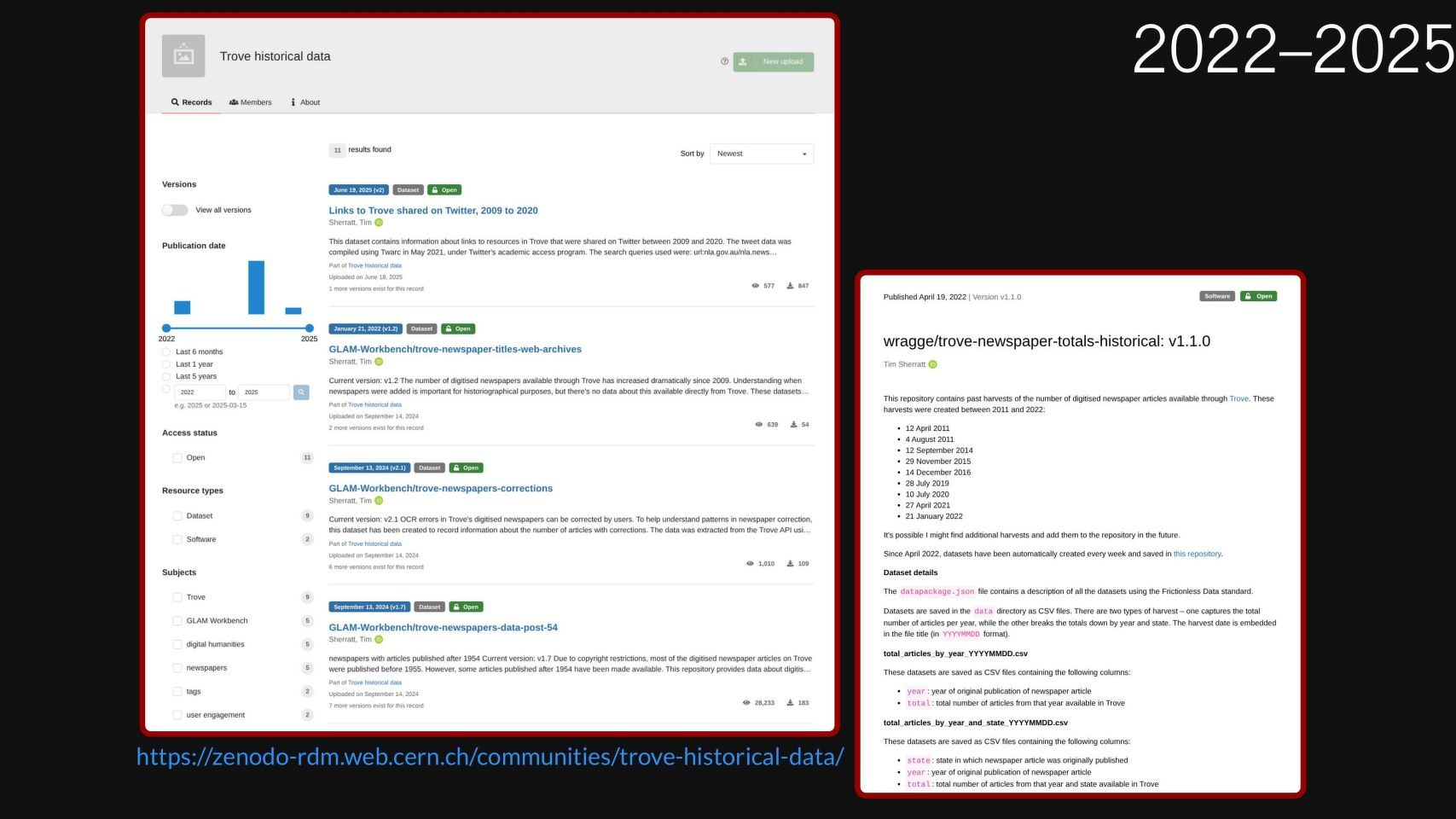
In a gesture towards that hypothetical future researcher, I’ve assembled an idiosyncratic collection of snapshots and datasets in Zenodo. They include things like the 2,495,958 public tags added to 10,403,650 resources in Trove from 2008 to 2024, lists of non-English newspapers in Trove, and the number of OCR corrections by year, article category, and newspaper title.
Perhaps my favourite set of collection snapshots comes from the National Archives of Australia’s RecordSearch database. The records of Australia’s federal government are supposed to available to the public after 20 years. However, some are withheld for reasons like national security and privacy. Each year, the NAA makes a big performance out of revealing newly-released cabinet records, which are duly reported by the media on 1 January. I thought it was only fair that the public should also see the list of records that were currently closed to public access. So every New Year’s Day for ten years, I harvested details of the files we weren’t allowed to see. I only stopped because the NAA introduced anti-bot measures that blocked my scraper script.
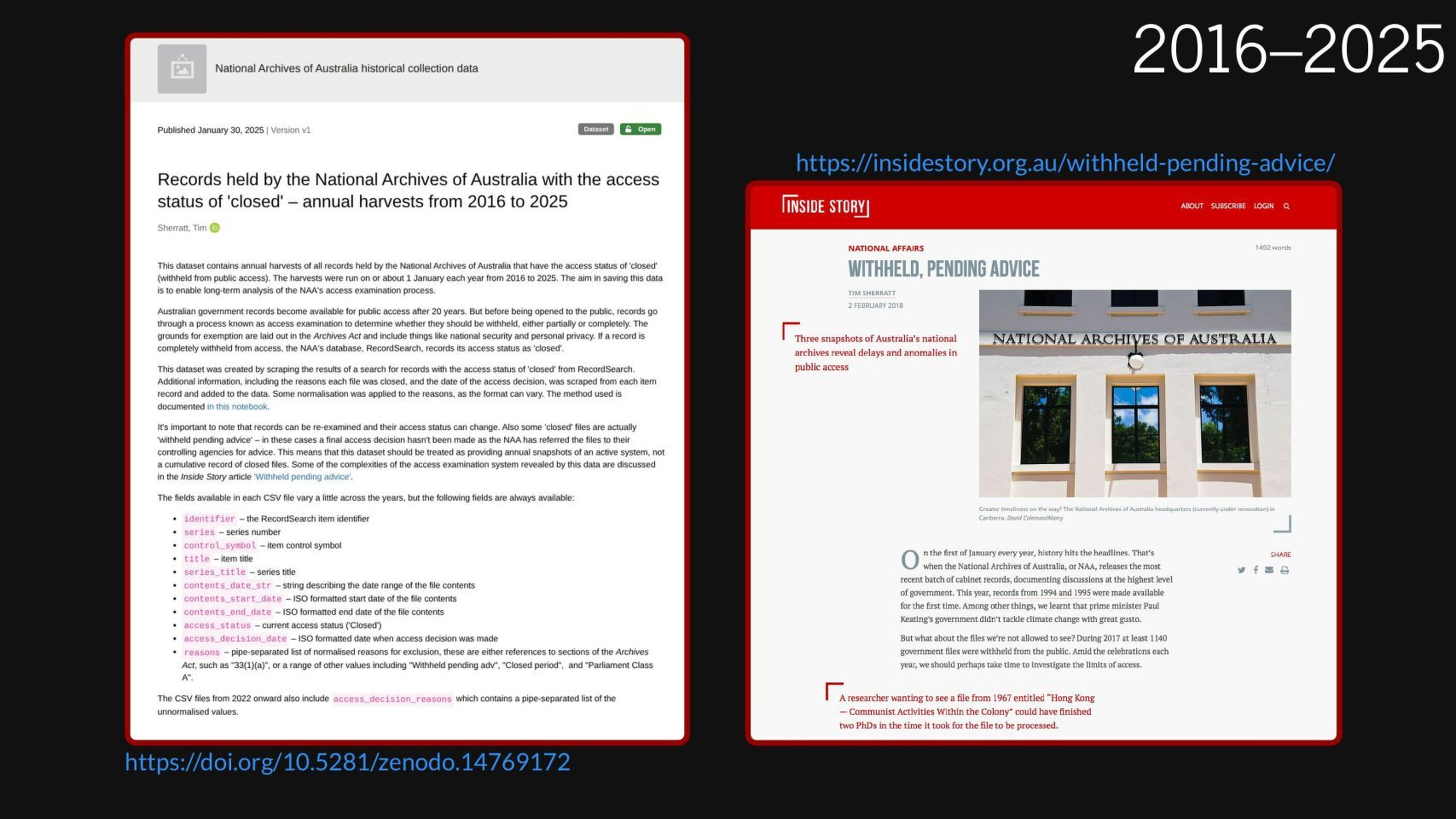
Beyond a little sly subversion, the data on closed files in the NAA is useful because it helps to document the workings of the access examination system – a point of much pain for researchers. Most of my work over the past 30 years has, in one way or another, explored the meaning of ‘access’ – how it is constructed, how that changes, and what it means for people using GLAM collections.
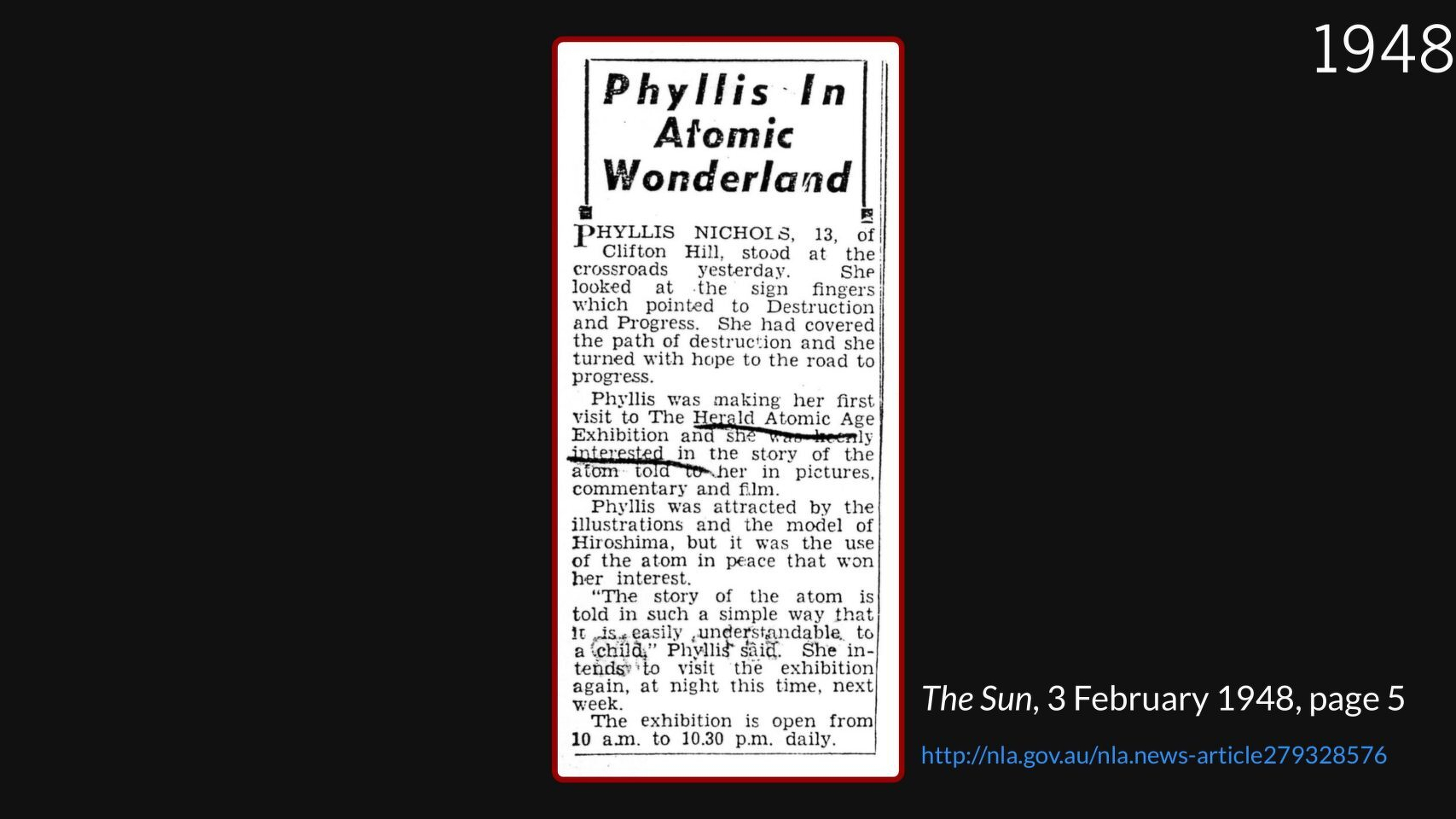
In January 1948, 13 year old Phyllis Nichols stood at the crossroads. She was visiting the Atomic Age Exhibition in Melbourne and according to the Sun newspaper:
She had covered the path of destruction and she turned with hope to the road to progress.
Such a weighty decision for a 13 year old. I must admit, there was a point where I seriously considered turning my thesis into a work of fiction focused on Phyllis’s adventures in atomic wonderland.
Phyllis chose well. But the crossroads metaphor was never really about choice. No-one was expected to pursue the path to nuclear annihilation. The crossroads demanded obedience to a specific vision of the future. It’s this way …or else.
‘Mapping Our Anzacs’ was created at a time of optimism, when it was thought that web technologies would open up the workings of government to new forms of public participation and transparency. But the dreams of ‘government 2.0’ have faded, as information becomes ever more tightly controlled. In the GLAM sector, APIs have come and gone. Datasets created for long past hack events linger without updates, almost forgotten. New defensive measures aimed at taming the onslaught of AI scraper bots have imposed extra limits on access. Meanwhile a handful of tech oligarchs tell us what our future will be. This is the reality of progress.
The work of GLAM Labs, of GLAM innovation, has always been focused on expanding the realm of the possible – encouraging people to see differently, to think differently. This work struggles constantly with the many meanings of ‘access’ – what use is data without good documentation, without permissive licences, without tools for analysis, without the skills of confidence to use those tools. It was this sort of struggle that motivated the GLAM Workbench.
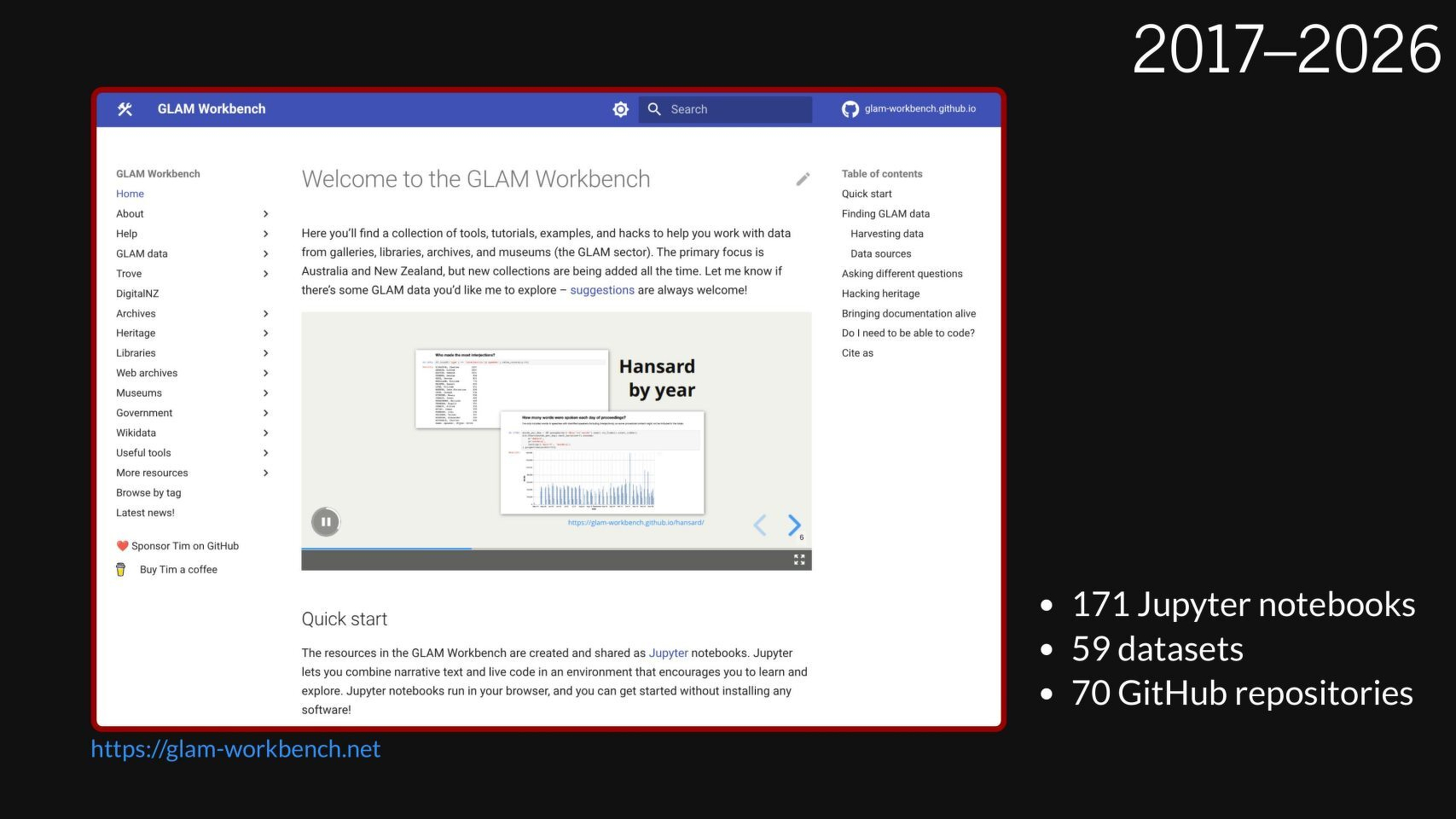
I recently wrote a potted introduction to the GLAM Workbench for a forthcoming publication on tool-making in the digital humanities. I won’t read it all out, but I think it gives a pretty good overview of where things are.
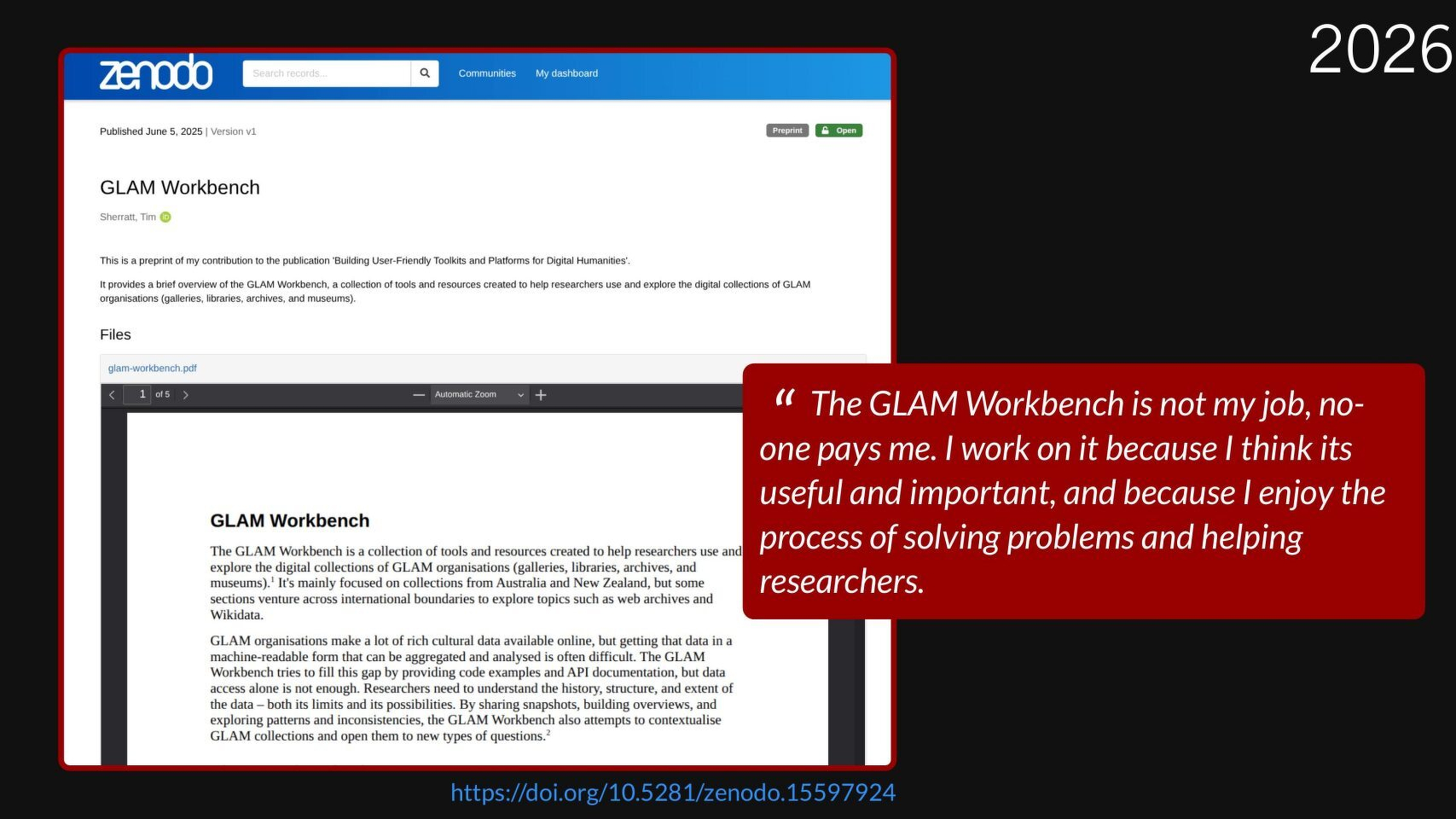
I suppose I want to emphasise though that the aim of the GLAM Workbench has always been to document possibilities – to expose researchers to the richness of GLAM data, to the new types of questions they can ask, and to the methods that are available to connect everything up.
In a world that erects multiple barriers of expertise, ownership, participation, and authority, there’s power in simply knowing what’s possible.
Back in 2010, at the first THATCamp Canberra, someone thanked me and said ‘I’ve found my people’. That sense of belonging was always what made the National Digital Forum in New Zealand so special. I’m not great at organisations – meetings make me anxious, and my email is a bin fire – but I do draw a lot of strength from the passions of like-minded people.
I don’t really know what the future of the GLAM Workbench will be. I’d like to be confident and optimistic, but the first half of last year was pretty bleak, and left me wondering whether I should just walk away from all of it – go bushwalking, catch up on gardening, perhaps just be a historian again. I was saved by the GLAM Labs community. First of all, by the fabulous folk at the State Library of Victoria’s LAB, particularly Paula Bray and Sotirios Alpanis. They gave me what I needed – fun data and wicked challenges. For a few months, I was back in my happy place, creating new pathways through the SLV’s place-based collections.
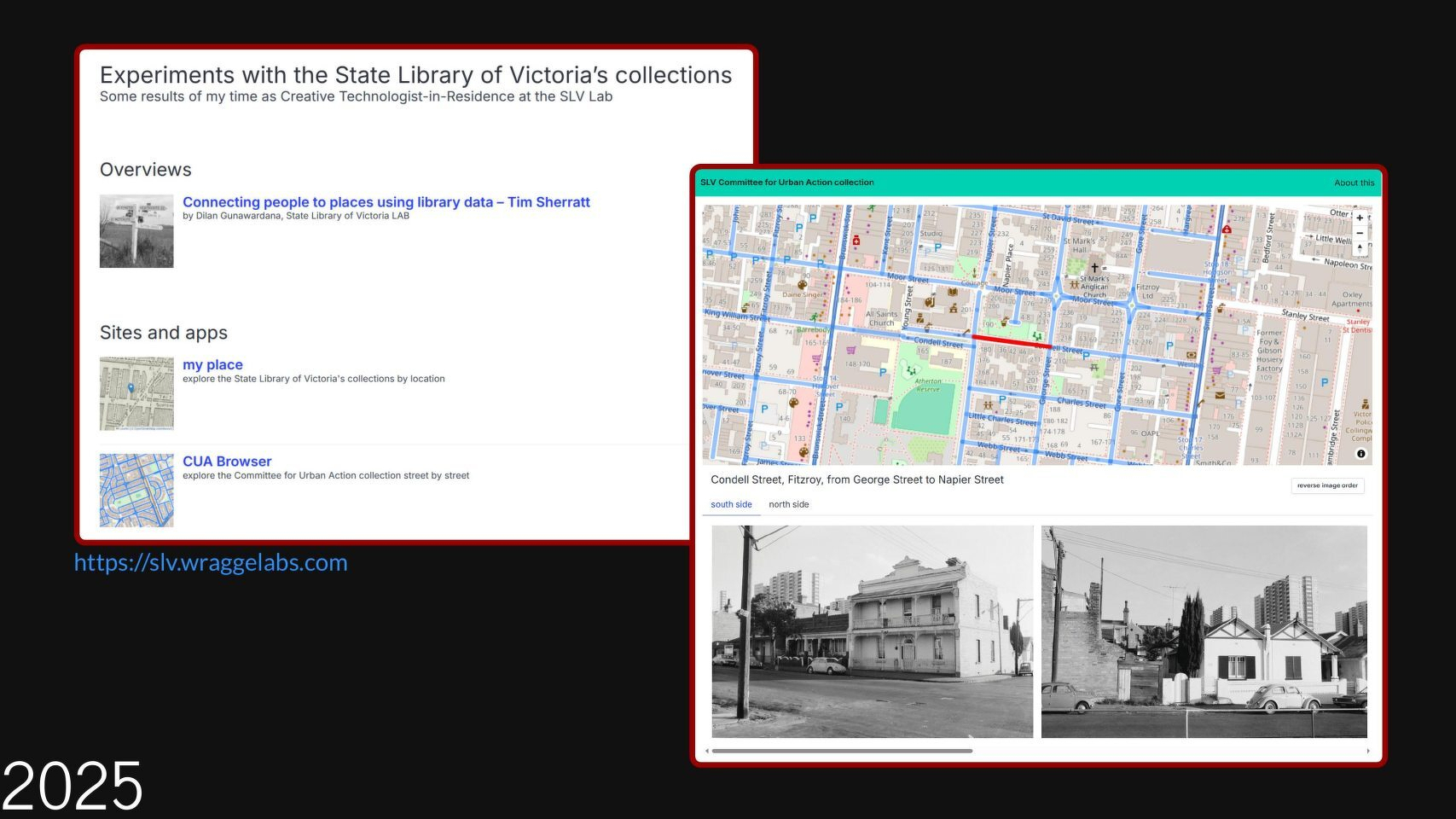
The second boost was, of course, the invitation to be here today – to find out what’s happening in labs around the world, to finally meet people I’ve known online for years, to join in the excitement and, yes, to share the disappointments.
Perhaps the GLAM Workbench has done it’s job. I think it’s helped give people the confidence to dip a toe in the world of collections as data. It’s also provided a useful model for GLAM organisations seeking to encourage new types of research. Perhaps its main value was always as an intervention – an invocation of possibilities that filled a particular gap at a particular moment in time. I’ve always tried to wrap the GLAM Workbench in layers of documentation to enable any lasting value to be extracted as needed. Perhaps my focus should be to make sure that documentation is complete.
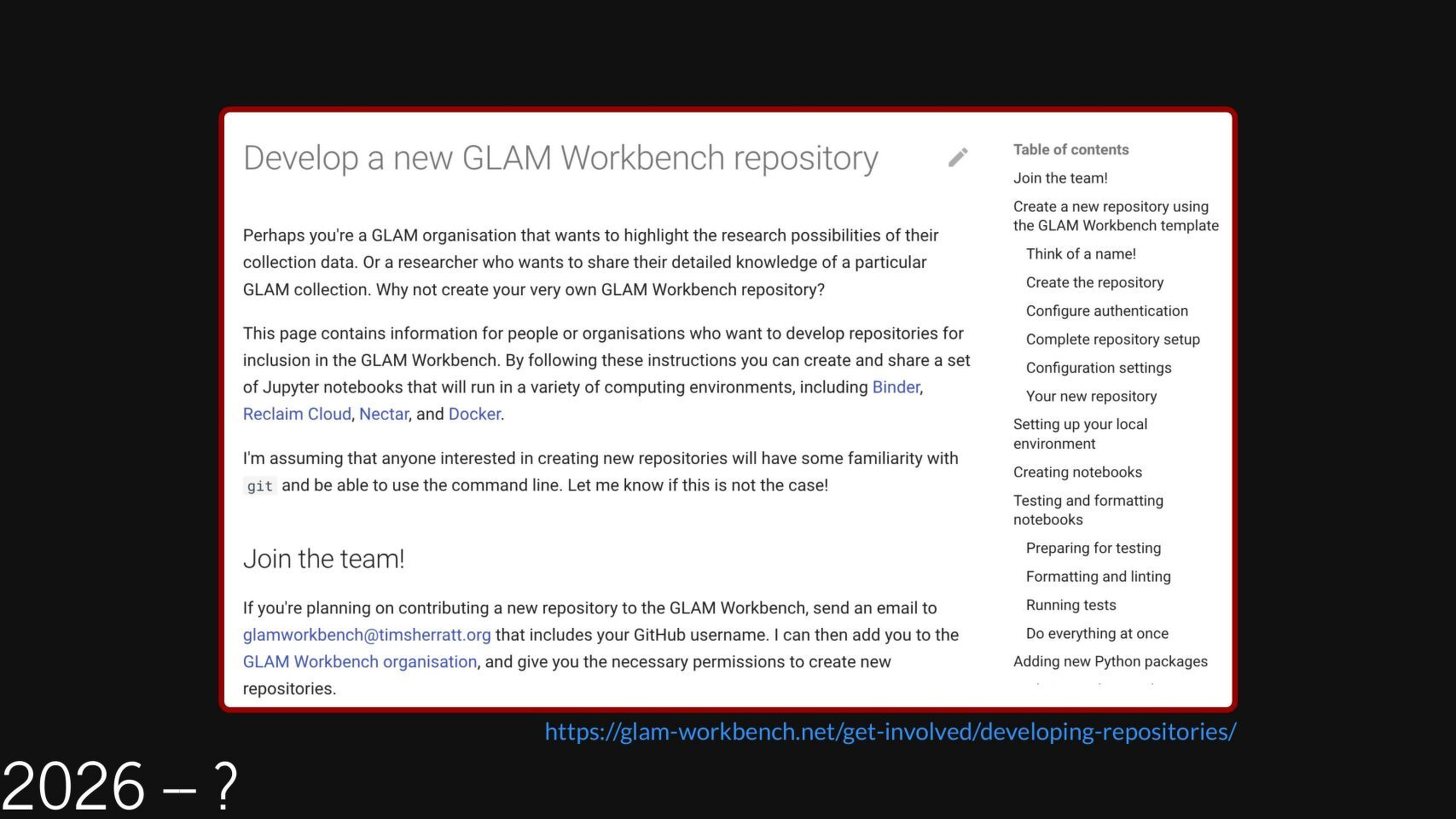
But it’s not a choice for me alone. The GLAM Workbench has always welcomed contributions, so if you’d like to carve out your own spaces, create your own sections, let me know! Perhaps the future of the GLAM Workbench will be shaped by the hands of others.
There’s also a lot of cool GLAM data out there to play around with, and it really doesn’t take much to get me excited about it. So perhaps I’ll just continue to follow my enthusiasms and see where that takes things.
All of these possible futures are good. The choices aren’t fixed – they leave the conversation with history open and constructive. I’m happy with that.
So greetings, thanks, and solidarity to all GLAM Labbers, past, present, and future. Despite all the setbacks and frustrations, your work matters. Take time to remember, to enjoy, and to celebrate.