Ahead of my session at #OzHA2022 tomorrow, I’ve updated the NAA section of the #GLAMWorkbench. Come along to find out how to harvest file details, digitsed images, and PDFs, from a search in RecordSearch! github.com/GLAM-Work…
glamworkbench
Noticed that QueryPic was having a problem with some date queries. Should be fixed in the latest release of the Trove Newspapers section of the #GLAMWorkbench: glam-workbench.net/trove-new… #maintenance #researchinfrastructure
The Trove Newspapers section of the #GLAMWorkbench has been updated! Voilá was causing a problem in QueryPic, stopping results from being downloaded. A package update did the trick! Everything now updated & tested. glam-workbench.net/trove-new…
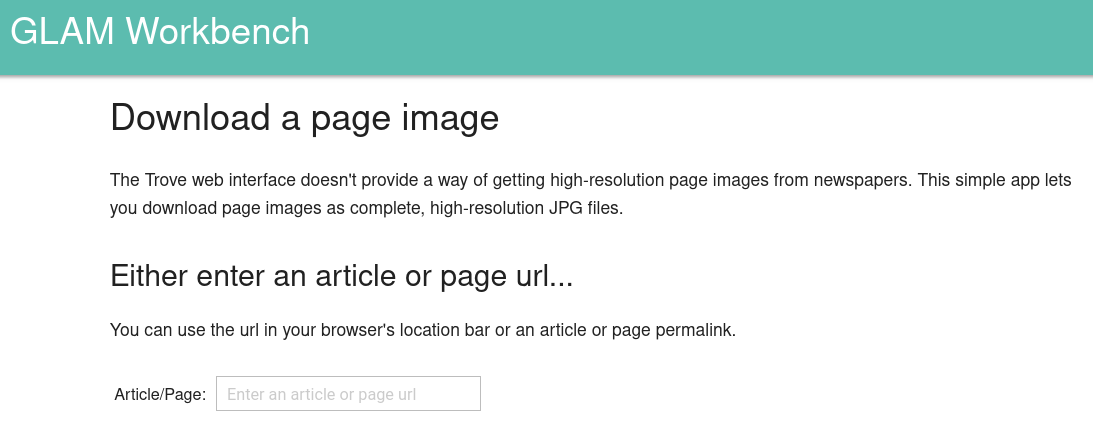
Some more #GLAMWorkbench maintenance – this app to download a high-res page images from Trove newspapers now doesn’t require an API key if you have a url, & some display problems have been fixed. trove-newspaper-apps.herokuapp.com/voila/ren…
The Trove Newspaper and Gazette Harvester section of the #GLAMWorkbench has been updated! No major changes to notebooks, just lots of background maintenance stuff such as updating packages, testing, linting notebooks etc. glam-workbench.net/trove-har…
Ordering some #GLAMWorkbench stickers…

Using Datasette on Nectar
Thursday, May 26, 2022
If you have a dataset that you want to share as a searchable online database then check out Datasette – it’s a fabulous tool that provides an ever-growing range of options for exploring and publishing data. I particularly like how easy Datasette makes it to publish datasets on cloud services like Google’s Cloudrun and Heroku. A couple of weekends ago I migrated the TungWah Newspaper Index to Datasette. It’s now running on Heroku, and I can push updates to it in seconds.
Convert your Trove newspaper searches to an API query with just one click!
Friday, May 20, 2022
I’m thinking about the Trove Researcher Platform discussions & ways of integrating Trove with other apps and platforms (like the GLAM Workbench). As a simple demo I modifed my Trove Proxy app to convert a newspaper search url from the Trove web interface into an API query (using the trove-query-parser package). The proxy app then redirects you to the Trove API Console so you can see the results of the API query without needing a key.
My Trove researcher platform wishlist
Wednesday, May 11, 2022
The ARDC is collecting user requirements for the Trove researcher platform for advanced research. This is a chance to start from scratch, and think about the types of data, tools, or interface enhancements that would support innovative research in the humanities and social sciences. The ARDC will be holding two public roundtables, on 13 and 20 May, to gather ideas. I created a list of possible API improvements in my response to last year’s draft plan, and thought it might be useful to expand that a bit, and add in a few other annoyances, possibilities, and long-held dreams.
Spending the evening updating the NAA section of the #GLAMWorkbench. Here’s a fresh harvest of the agency functions currently being used in RecordSearch… gist.github.com/wragge/d1…
Working with Trove data – a collection of tools and resources
Monday, May 2, 2022
The ARDC is organising a couple of public forums to help gather researcher requirements for the Trove component of the HASS RDC. One of the roundtables will look at ‘Existing tools that utilise Trove data and APIs’. Last year I wrote a summary of what the GLAM Workbench can contribute to the development of humanities research infrastructure, particularly in regard to Trove. I thought it might be useful to update that list to include recent additions to the GLAM Workbench, as well as a range of other datasets, software, tools, and interfaces that exist outside of the GLAM Workbench.
And so it starts… #GLAMWorkbench
Ok, I’ve created a new #GLAMWorkbench meta issue to try and bring together all the things I’m trying to do to improve & automate the code & documentation. This should help me keep track of things… github.com/GLAM-Work… #DayofDH2022
A couple of hours of #DayofDH2022 left – feeling a bit uninspired, so I’m going to do some pruning & reorganising of the #GLAMWorkbench issues list: github.com/GLAM-Work…
Tracking Trove changes over time
Wednesday, April 20, 2022
I’ve been doing a bit of cleaning up, trying to make some old datasets more easily available. In particular I’ve been pulling together harvests of the number of newspaper articles in Trove by year and state. My first harvests date all the way back to 2011, before there was even a Trove API. Unfortunately, I didn’t run the harvests as often as I should’ve and there are some big gaps. Nonetheless, if you’re interested in how Trove’s newspaper corpus has grown and changed over time, you might find them useful.
The GLAM Workbench wants you!
Wednesday, March 2, 2022
Over the past few months I’ve been doing a lot of behind-the-scenes work on the GLAM Workbench – automating, standardising, and documenting processes for developing and managing repositories. These sort of things ease the maintenance burden on me and help make the GLAM Workbench sustainable, even as it continues to grow. But these changes are also aimed at making it easier for you to contribute to the GLAM Workbench! Perhaps you’re part of a GLAM organisation that wants to help researchers explore its collection data – why not create your own section of the GLAM Workbench?
Omeka S Tools – new Python package
Thursday, February 17, 2022
Over the last couple of years I've been fiddling with bits of Python code to work with the Omeka S REST API. The Omeka S API is powerful, but the documentation is patchy, and doing basic things like uploading images can seem quite confusing. My code was an attempt to simplify common tasks, like creating new items. In case it's of use to others, I've now shared my code as a Python package.
Testing, testing...
Friday, January 28, 2022
I regularly update the Python packages used in the different sections of the GLAM Workbench; though probably not as often as I should. Part of the problem is that once I've updated the packages, I have to run all the notebooks to make sure I haven't inadvertently broken something -- and this takes time. And in those cases where the notebooks need an API key to run, I have to copy and paste the key in at the appropriate spots, then remember to delete them afterwords.
Some big pictures of newspapers in Trove and DigitalNZ
Thursday, December 9, 2021
One of the things I really like about Jupyter is the fact that I can share notebooks in a variety of different formats. Tools like QueryPic can run as simple web apps using Voila, static versions of notebooks can be viewed using NBViewer, and live versions can be spun up as required on Binder. It’s also possible to export notebooks at PDFs, slideshows, or just plain-old HTML pages. Just recently I realised I could export notebooks to HTML using the same template I use for Voila.
Exploring GLAM data at ResBaz
Thursday, December 9, 2021
The video of my key story presentation at ResBaz Queensland (simulcast via ResBaz Sydney) is now available on Vimeo. In it, I explore some of the possibilities of GLAM data by retracing my own journey through WWI service records, The Real Face of White Australia, #redactionart, and Trove – ending up at the GLAM Workbench, which brings together a lot of my tools and resources in a form that anyone can use.
GLAM Workbench Nectar Cloud Application updated!
Wednesday, December 1, 2021
The newly-updated DigitalNZ and Te Papa sections of the GLAM Workbench have been added to the list of available repositories in the Nectar Research Cloud’s GLAM Workbench Application. This means you can create your very own version of these repositories running in the Nectar Cloud, simply by choosing them from the app’s dropdown list. See the Using Nectar help page for more information. I’ve also taken the opportunity to make use of the new container registry service developed by the ARDC as part of the ARCOS project.
DigitalNZ & Te Papa sections of the GLAMWorkbench updated!
Wednesday, December 1, 2021
In preparation for my talk at ResBaz Aotearoa, I updated the DigitalNZ and Te Papa sections of the GLAM Workbench. Most of the changes are related to management, maintenance, and integration of the repositories. Things like: Setting up GitHub actions to automatically generate Docker images when the repositories change, and to upload the images to the Quay.io container registry Automatic generation of an index.ipynb file based on README.md to act as a front page within Jupyter Lab Addition of a reclaim-manifest.
A template for GLAM Workbench development
Thursday, November 11, 2021
I’m hoping that the GLAM Workbench will encourage GLAM organisations and GLAM data nerds (like me) to create their own Jupyter notebooks. If they do, they can put a link to them in the list of GLAM Jupyter resources. But what if they want to add the notebooks to the GLAM Workbench itself? To make this easier, I’ve been working on a template repository for the GLAM Workbench. It generates a new skeleton repository with all the files you need to develop and manage your own section of the GLAM Workbench.
Coming up! GLAM Workbench at ResBaz(s)
Thursday, November 4, 2021
Want a bit of added GLAM with your digital research skills? You’re in luck, as I’ll be speaking at not one, but three ResBaz events in November. If you haven’t heard of it before, ResBaz (Research Bazaar) is ‘a worldwide festival promoting the digital literacy at the centre of modern research’. On Wednesday, 24 November I’ll be giving a key story presentation (like a keynote, but with more story!) entitled Exploring GLAM data for ResBaz Queensland.
New video – using the Trove Newspaper & Gazette Harvester
Monday, November 1, 2021
The latest help video for the GLAM Workbench walks through the web app version of the Trove Newspaper & Gazette Harvester. Just paste in your search url and Trove API key and you can harvest thousands of digitised newspaper articles in minutes!
Harvest newspaper issues as PDFs
Monday, November 1, 2021
An inquiry on Twitter prompted me to put together a notebook that you can use to download all available issues of a newspaper as PDFs. It was really just a matter of copying code from other tools and making a few modifications. The first step harvests a list of available issues for a particular newspaper from Trove. You can then download the PDFs of those issues, supplying an optional date range.
GLAM Workbench now in the Nectar Research Cloud!
Thursday, October 21, 2021
The GLAM Workbench isn’t dependent on one big piece of technological infrastructure. It’s basically a collection of Jupyter notebooks, and those notebooks can be used within a variety of different environments. This helps make the GLAM Workbench more sustainable – new components can be swapped in and out as required. It also makes it possible to create different pathways for users, depending on their digital skills, institutional support, and research needs.
More GLAM Name Index updates from Queensland State Archives and SLWA
Monday, October 18, 2021
A new version of the GLAM Name Index Search is available. An additional 49 indexes have been added, bringing the total to 246. You can now search for names in more than 10.2 million records from 9 organisations. The new indexes come from Queensland State Archives and the State Library of WA. QSA announced on Friday that they’d added two new indexes to their site. When I went to harvest them, I realised there was another 25 indexes that I hadn’t previously picked up.
Getting data about newspaper issues in Trove
Friday, October 15, 2021
When you search Trove’s newspapers, you find articles – these articles are grouped by page, and all the pages from a particular date make up an issue. But how do you find out what issues are available? How do you get a list of dates when newspapers were published? This notebook in the GLAM Workbench shows how you can get information about issues from the Trove API. Using the notebook, I’ve created a couple of datasets ready for download and use.
GLAM Workbench at eResearch Australasia 2021
Friday, October 15, 2021
Way back in 2013, I went to the eResearch Australasia conference as the manager of Trove to talk about new research possibilities using the Trove API. Eight years years later I was back, still spruiking the possibilities of Trove data. This time, however, I was discussing Trove in the broader context of GLAM data – all the exciting possibilities that have emerged as galleries, libraries, archives and museums make more of their collections available in machine-readable form.